The guide
A Truchet pattern looks like chance, but every curve in it either closes or walks out of the frame
One square tile, turned at random, fills a wall with loops and wandering paths. The picture is unpredictable; its structure is fixed before the first tile is laid.
- 1704 the year Truchet published his study of the two-color tile
- two orientations all that Smith's arc tile has, so a pattern is a grid of coin flips
- 1 in 16 chance that four random tiles close a circle round a corner
- 21 open paths in every 12 by 9 arc grid, whatever the tiles do
- 1/3 and 2/3 where the curves of the multi-scale tiles meet each side
Read the full guide Fold the guide
Lay a hundred identical tiles on a table, each printed with two quarter circles, and turn every one by the toss of a coin. What appears looks like a tangle. It is nothing of the kind.
Every line in that tangle is either a closed loop or a path that enters at one edge of the table and leaves at another. No line stops. No line forks. The surface is cut into regions that can be painted in just two colors with no two neighbors alike. All of this is true for any toss of the coins, and it follows from the tile, not from the luck.
That is the pleasure of Truchet tiles, and it is why they reward being counted as well as looked at. The chance decides which picture you get. The tile decides what kind of picture is possible.
A priest and a pile of floor tiles
Father Sébastien Truchet was born in Lyon in 1657 and died in 1729. Jacques André and Denis Girou, writing for typographers, list what else he did: he was an expert in hydraulics who worked on French canals, an inventor, the man behind the typographic point, and a designer of the royal typeface known as the Romain du roi.
The tiles came from a canal trip. In a château near Orléans, Truchet wrote, he found ceramic tiles meant for the floor of a chapel and some apartments. They were square and “divided by a diagonal line into two coloured parts”. To form pleasing designs, he went on, he “first examined the number of ways in which these tiles could be joined together in pairs, always in checkerboard array”.
He published the result in 1704. Tiling was old, André and Girou note, but Truchet was the first to publish a systematic study of all the combinations of one. His tile can sit four ways. David Reimann summarizes the count for pairs: 64 possible combinations, which fall into 10 classes once rotations are allowed for. The plates then show larger blocks, patterns built by rule from that small alphabet.
What was he studying? Not ornament alone. Cyril Stanley Smith, quoted by Eric Lord and S. Ranganathan, called the memoir “in essence a graphical treatment of combinatorics”, a subject that Pascal, Fermat and Leibniz had put at the front of mathematics at the time. Truchet coded each orientation with a letter and wrote patterns as words. Father Dominique Douat extended the method in a book of 1722, and Peter Kagey and William Keehn observe that both works were partly meant as references for artists, architects and designers.
Smith bends the diagonal
Then the idea slept. It was Smith, a metallurgist and historian of science, who brought it back in 1987 in the journal Leonardo, with a translation of the memoir and ideas of his own. One was to drop Truchet’s rules and lay the tiles at random. Another was a new tile.
Smith’s tile has no colored halves. It carries two circular arcs, each of radius half the tile’s side, centered on two opposite corners, so that each arc joins the midpoints of two adjacent sides. Turn it a quarter turn and you get its mirror image; turn it again and you are back. It has just two orientations. A pattern of n tiles is therefore exactly n coin flips, and Christopher Carlson says that this version has become the most popular expression of the whole concept.
Kerry Mitchell puts the reason it works in one sentence: the arcs meet the sides at right angles and at their centers, so any tile laid against any other continues its curves smoothly. Nothing has to be matched. The games Trax and the Black Path Game had used the same tile earlier, as the usual references note, but it was Smith’s article that tied it to Truchet’s name, which it has carried, a little confusingly, ever since.
Why nothing is left dangling
Stand on any arc and walk. At the end of the arc you are at the midpoint of a side. If the side belongs to the frame, you have left the pattern. If not, there is a tile beyond it, and exactly one arc of that tile starts where you stand. So the walk goes on, and it never has a choice to make.
A walk with no choices on a finite board can only do two things. It can reach the frame, or it can return to where it began. That is the whole proof that every curve is a closed loop or a path from edge to edge, and it also counts the open paths. A grid 12 tiles wide and 9 high has 42 side midpoints on its frame. Each open path uses two. So it has 21 open paths, always.
The two colors come from the corners. Every side of every tile is crossed once, at its midpoint, so stepping from one grid corner to the next always crosses exactly one curve. Color the region around each corner by whether its row plus its column is even or odd, and neighbors across a curve must differ. Lord and Ranganathan describe the same fact from the picture: the sinuous line partitions the plane into two kinds of region.
Here is an example to try. Choose quarter arcs, a grid 12 wide and 9 high, the random rule and seed 1704. The tool reports 13 closed loops, 10 of them single circles, and 21 open paths; the longest loop runs 12.6 tile widths. Change the seed and the first numbers move. The 21 does not.
The circles can be predicted too. A circle closes around an inner corner when the four tiles that meet there all turn the right way, a chance of 1 in 16. This grid has 88 inner corners, so 5.5 circles are expected and seed 1704 is a generous draw. The published figure, due to Clifford Pickover and quoted by Lord and Ranganathan, is about 0.054 circles per tile for a random tiling.
Smaller tiles, and pictures
Can tiles of different sizes share a pattern? Carlson’s answer, from 2018, starts by moving the curves. If the arcs meet each side at 1/3 and 2/3 instead of at the middle, a tile half the size can sit against a larger one and their curves line up. Loose ends remain, and Carlson’s trick for them is the winged tile: each tile’s motif spills a little past its square, smaller tiles are always laid on top of larger ones, and the two colors swap at every step down in size. He uses fifteen motifs, seven up to rotation, and patterns at one scale become the background for the next.
The same third-points turn out to be useful for pictures. Amy Wendt’s halftoning work uses a family of such tiles precisely because its members cover different shares of the square with ink, so a tile can be chosen to match the local brightness of an image. An earlier paper of hers tunes one tile’s brightness by bending the boundary between its two colors. That is the principle behind driving a pattern from a photograph. With the arc tile, where every orientation carries the same ink, the band has to change width instead.
What survives of the picture depends on how many tiles it gets. Measured on a test image, the ink laid down by 40 by 40 arc tiles tracked the darkness of the image almost perfectly when averaged over blocks of a few tiles. At 12 by 12 the tones were still in the right order, but a face would not be a face. And the range is limited: bands cannot vanish or fill the tile, so the lightest areas stay about a sixth inked and the darkest about four fifths.
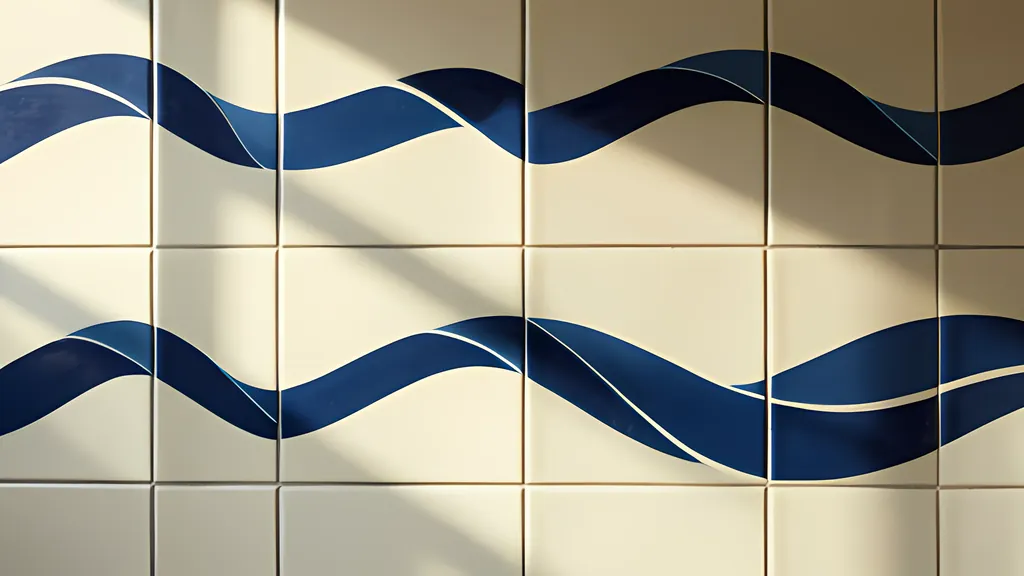
Hidden pictures of another kind are possible without any change of width. Reimann showed in 2009 that letters can be spelled in the curves themselves by fixing some tiles and leaving the rest random, and Cindy Lawrence describes how the National Museum of Mathematics used the method for the tiled walls of its restrooms.
From the screen to a pen
A loop is a gift to a machine that draws. A pen plotter spends its time in two ways, drawing and travelling with the pen up, and plotter software works to reduce the second: the AxiDraw reference lists joining path ends that lie close together and reordering paths for speed among its steps. A traced Truchet pattern arrives already joined. Each loop can be written as one path, to be drawn without lifting.
In an SVG file that path is a chain of arc commands, each giving a radius, two flags that pick which of the possible arcs is meant, and an end point. A DXF file for a laser or a router wants vertices instead, with a flag that says the polyline is closed, so each arc must become short chords, and the honest thing is to state how far the chords stray. Printing at full size on ordinary paper means cutting the pattern into sheets that overlap and carry marks to line them up.
What can the method not do? It will not make a maze with one solution, or a knot; arcs that never cross cannot weave, and adding a crossing tile changes the rules of coloring only slightly but the look a great deal. It cannot two-color a seamless repeat that is an odd number of tiles across. Triangles cannot carry a one-point-per-side tile at all, as Mitchell points out, though hexagons can and Douglas Dunham has carried the idea into the hyperbolic plane.
And it cannot surprise its own arithmetic. That, in the end, is what Truchet saw in a stack of floor tiles: a small set of pieces whose every arrangement could be written down, counted and compared. Three centuries later the pieces are curved and the arrangements come from a seed. The counting still comes out exact.
Sources
Every source consulted for this guide. Links checked October 7, 2026.
- Father Truchet, the typographic point, the Romain du roi, and tilings Jacques André and Denis Girou, TUGboat 20 (1999), TeX Users Group
- Truchet Tilings and their Generalisations E. A. Lord and S. Ranganathan, Resonance (2006), Indian Academy of Sciences
- Multi-Scale Truchet Patterns Christopher Carlson, Bridges 2018, The Bridges Archive
- Connections between Hitomezashi Patterns and Truchet Tiling David A. Reimann, Bridges 2023, The Bridges Archive
- Text from Truchet Tiles David A. Reimann, Bridges 2009, The Bridges Archive
- Generalizations of Truchet Tiles Kerry Mitchell, Bridges 2020, The Bridges Archive
- Play Truchet: Using the Truchet Tiling to Engage the Public with Mathematics Cindy Lawrence, Bridges 2018, The Bridges Archive
- Hyperbolic Truchet Tilings Douglas Dunham, University of Minnesota Duluth
- Counting Tilings of the n × m Grid, Cylinder, and Torus Peter Kagey and William Keehn, Journal of Integer Sequences 27 (2024)
- Halftoning with Layered CMYK Color Truchet Tile Mosaics Amy E. Wendt, Bridges 2025, The Bridges Archive
- Adjustable Duotone Mosaic Tile Brightness via Bézier Boundaries Amy E. Wendt, Bridges 2022, The Bridges Archive
- Truchet tiling Wikipedia
- d - SVG | MDN MDN Web Docs, Mozilla
- Polyline - ezdxf 1.4.4 documentation ezdxf project, Manfred Moitzi (MIT licence)
- AxiDraw CLI Reference Evil Mad Scientist, AxiDraw documentation