The guide
A moiré is the difference between two patterns, drawn large enough to see
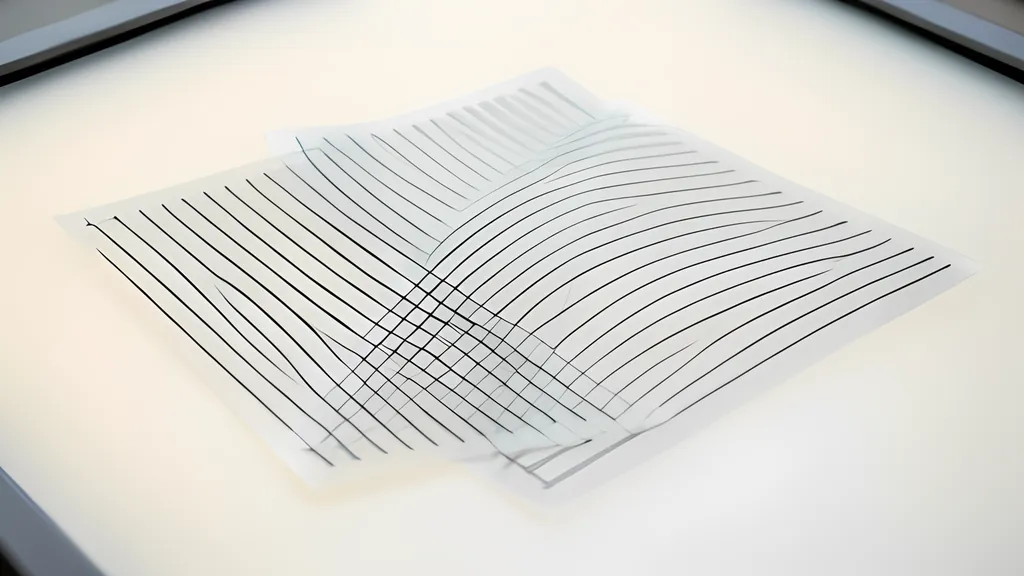
Lay one fine grating over another and broad bands appear that belong to neither sheet. They are arithmetic made visible, and the arithmetic is short.
- 17.19 mm fringe spacing of two 1.2 mm gratings crossed at 4 degrees
- 14.3 times how much farther those fringes move than the sheet that slides
- 1874 Lord Rayleigh tests gratings too fine to see by their moiré
- 1650s moire enters English as a word for watered silk
- 121 mm bands made by a 1 percent printing error on a 1.2 mm grating
Read the full guide Fold the guide
Hold two window screens a hand apart and look through both. Bands appear, far wider than any wire, and they swim when you move your head. Neither screen has bands. Take one away and they are gone.
That is a moiré, and the usual way to describe it, as a kind of optical accident, undersells it. The bands are a subtraction. Each screen is a regular pattern with its own spacing and direction; the bands are what is left when one is taken from the other. Because the two screens are nearly alike, what is left is small, and a small difference in a fine pattern shows up as a coarse one. Once that is clear, everything else about moiré follows: why it magnifies, why it is so sensitive, why it ruins some pictures and measures others.
A word from the silk trade
The name is older than the optics. The Online Etymology Dictionary dates moire, meaning watered silk, to the 1650s in English, borrowed from French, which had it in turn from the English word mohair. The adjective moiré, for anything with that watered look, is attested from 1823. The cloth earned the name honestly: Wikipedia’s account of the textile says it was made by pressing two layers together while wet, so that the nearly but not exactly matching threads left a rippled figure in the finish.
So the fabric and the physics are the same event. Two sets of threads, almost aligned, pressed into one surface. Lecture slides from the University of Washington put it in one line: moiré is the French name for a fabric called water silk, one that shows patterns of light and dark bands.
Why two fine things make a coarse one
The standard optics text on the subject, the chapter by K. Creath, J. Schmit and J. C. Wyant in Optical Shop Testing, calls a moiré a beat pattern between two gratings of approximately equal spacing. A dark fringe forms where the dark lines of one sheet fall in the gaps of the other, a bright one where dark lines sit on dark lines and the gaps line up. Musicians know the same thing as the slow throb between two strings that are almost in tune.
The first step in the mathematics is to decide how two sheets combine. Isaac Amidror and Roger Hersch, of the Swiss Federal Institute of Technology in Lausanne, give the reason for the usual choice: black laid over anything gives black, so the light that gets through two printed films is the product of what gets through each. Multiply two regular patterns and, by a standard result of Fourier theory, the product contains every frequency of each original plus two new ones, the sum and the difference of the originals.
The sum is finer than either sheet and the eye loses it. The difference is the moiré. Amidror and Hersch draw a small circle at the center of the spectrum, standing for the finest detail a viewer can resolve at a given distance, and observe that the difference frequency often lands inside it when the two originals do not. You can stand too far back to see a single line and still see the bands perfectly well.
For two sets of straight lines the difference is a short formula. With spacings p1 and p2 and an angle between the two sets, the fringe spacing is p1 times p2, divided by the square root of p1 squared plus p2 squared minus twice p1 p2 times the cosine of the angle. Creath, Schmit and Wyant give it in an equivalent form and note the two limits that matter in practice.
If the sheets are parallel but differ slightly in spacing, the fringes are p1 p2 divided by the difference of the two, and they run parallel to the lines. If the spacings are equal and one sheet is turned, the fringes are the spacing divided by twice the sine of half the angle, which for a small angle is simply the spacing divided by the angle in radians, and they run almost square to the lines.
Take two gratings with lines 1.2 mm apart and turn one by 4 degrees. Four degrees is 0.0698 radians, and 1.2 divided by 0.0698 is 17.19 mm. The exact formula gives 17.19 mm as well. Set those two numbers in the tool above and the predicted spacing reads 17.19 mm; the spacing measured from the rendered picture, by a Fourier transform of the image itself, agrees with it to within a hundredth of a millimetre.
Halve the angle and the bands double in width. At one degree they are 68.8 mm apart, wider than most of the sheet. At zero they are infinitely wide, which is to say there are none. Amidror calls that state a singular one and warns that it is unstable: any slight deviation in angle or scale brings the moiré back from infinity.
Now slide the turned sheet across its own lines by a quarter of a period, 0.3 mm. The fringes move a quarter of their own period, 4.3 mm. Amidror’s 2003 paper gives the rule exactly: the moiré shifts by the layer’s shift multiplied by one over twice the sine of half the angle. Here that factor is 14.3 times. A movement too small to notice becomes one you can measure with a ruler. Wikipedia’s article on the moiré pattern records the practical use: in micrometers the effect amplifies very small movements. The displacement is magnified.
The nuisance
Most people meet moiré as a fault. Creath and her coauthors list the everyday cases: two window screens, a halftone picture screened a second time, a striped shirt seen on television.
The halftone case is the printer’s version. Penn State University Press tells its authors not to scan pictures out of books and magazines, because a printed photograph is already a pattern of dots and the scan lays a second pattern over it. Descreening can reduce the result, the press adds, but usually softens the detail. A Virginia Tech dissertation of 1996 treated the scanner problem at full length, working out the frequency, phase and geometry of the moiré in a sampled halftone. Color printing has the same trouble built in: Amidror notes that three or four dot screens must be overprinted, one for each ink, and that periodic screens can produce strong unwanted moirés between them.
The camera case is a subtraction against the sensor. Wikipedia’s article on aliasing gives the rule from sampling theory: detail finer than half the sampling frequency, the Nyquist frequency, comes back as coarse detail that was never in the scene, and its standard example is the moiré in a poorly sampled picture of a brick wall. Camera makers fit an optical low-pass filter, also called a blur filter, in front of the sensor to remove such detail before it is sampled.
The same article points out a trap for anyone checking a picture on a screen: aliasing can arise when an image is displayed as well as when it is taken, so a picture reduced in resolution without proper filtering shows a moiré that the full-size image does not contain.
That last point applies to any picture of a moiré on a screen, including the one above. A display is itself a grid. The tool therefore averages each pixel over its true area instead of sampling a point, states the limit of two pixels to a line below which no screen can carry the pattern, and offers a magnified view.
The instrument and the art
The same sensitivity that spoils a scan makes a gauge. The chapter by Creath, Schmit and Wyant records that Lord Rayleigh introduced the idea in 1874: he judged the quality of diffraction gratings by the moiré between two of them, even though the lines of each were too fine to resolve under a microscope.
Engineers use it to watch things stretch. In the method described in the University of Washington lecture slides, one grating is fixed to the specimen and an undistorted master is laid over it. One new fringe appears each time the specimen stretches by one line spacing, so counting fringes along a known length gives the strain directly. Stretching makes fringes parallel to the lines and rotation makes fringes nearly square to them, which is how the two are told apart.
Opticians use it to think. Wyant’s page at the University of Arizona offers printable patterns precisely because the moiré of two line gratings predicts where the fringes of two interfering plane waves will fall, and two sets of concentric rings give the hyperbolas of two point sources. The chapter is careful about the limit of the analogy: the fringe centers are right, the brightness profile is not.
Artists found it in the same years. In May 1963 Gerald Oster and Yasunori Nishijima published an article called Moiré Patterns in Scientific American. From February 23 to April 25, 1965, the Museum of Modern Art in New York held The Responsive Eye, an exhibition that Wikipedia’s account of op art describes as focused on the perceptual side of art, the illusion of movement and the interaction of colors, with Bridget Riley and Victor Vasarely among those shown.
Later that year Oster published a paper titled Optical Art in the journal Applied Optics. Its abstract traces the history of the movement and lists the moiré technique among the main methods of optical artists, beside the juxtaposition of colors, three-dimensional projections and the use of optical components.
Printing two films that work
A printed pair obeys the same arithmetic, which is both the appeal and the hazard. Suppose two identical 1.2 mm gratings are printed and one comes out 1 percent large because the printer was told to fit the page. Its lines are now 1.212 mm apart, and the beat formula gives bands 121 mm wide where none were intended. Print at actual size, and check a ruled length on the sheet before trusting the result.
Thickness matters too. Sheets held apart are seen at slightly different scales, so the bands shift as the eye moves; the tool models this with plain geometry and nothing more. Press the films face to face to remove it, or keep the gap on purpose and enjoy it.
The formula has limits that are worth stating. It describes straight lines and the first, strongest difference only; Amidror’s books run to two volumes because curved layers, dot screens and higher-order terms each add their own cases, and because Fourier theory alone does not account for the small rosette shapes inside the bands. For curved patterns the spacing changes from place to place and no single number describes it. And no formula can tell you whether the bands you see belong to your two sheets or to the screen you are viewing them on.
Sources
Every source consulted for this guide. Links checked October 6, 2026.
- Optical Metrology of Diffuse Surfaces K. Creath, J. Schmit and J. C. Wyant, chapter 16 of Optical Shop Testing, Third Edition (Wiley, 2007), copy hosted by the University of Lille
- The role of Fourier theory and of modulation in the prediction of visible moiré effects Isaac Amidror and Roger D. Hersch, Journal of Modern Optics 56 (2009), copy hosted by EPFL
- Unified approach for the explanation of stochastic and periodic moirés Isaac Amidror, Journal of Electronic Imaging 12 (2003), copy hosted by EPFL
- The Theory of the Moire Phenomenon by I. Amidror Peripheral Systems Laboratory, EPFL
- Explanation of moiré - Field Guide to Interferometric Optical Testing E. P. Goodwin and J. C. Wyant, SPIE Press, on SPIE Optipedia
- Moiré Patterns - James C. Wyant Wyant College of Optical Sciences, University of Arizona
- Moiré Method Wei-Chih Wang, ME 557 lecture slides, University of Washington
- Moire - Etymology, Origin & Meaning Online Etymology Dictionary
- Moiré pattern - Wikipedia Wikipedia
- Halftones: A Necessary Step in the Printing Process Penn State University Press, author resources
- Analysis and Reduction of Moire Patterns in Scanned Halftone Pictures Virginia Tech doctoral dissertation (1996), VTechWorks
- Aliasing Wikipedia
- Anti-aliasing filter Wikipedia
- Op art Wikipedia
- Moiré Patterns OpenAlex catalogue record W4256217128 (Gerald D. Oster and Yasunori Nishijima, Scientific American, vol. 208, no. 5, 1963)
- Optical Art OpenAlex catalogue record W4254036930 (Gerald D. Oster, Applied Optics, vol. 4, no. 11, 1965)