The guide
A kumihimo braid is decided before the first move: the pattern is in where the colors start
The round braid called kongo gumi repeats one small move for its whole length. What changes from braid to braid is the order of the colors around the disk, and that can be worked out before any thread is cut.
- 32 moves one full repeat of the round braid on sixteen strands
- 1,162 different two-color braids of sixteen strands, counted in 2022
- 2002 year the foam braiding disk was created, by Makiko Tada
- 3 x a common rule of thumb for strand length; a sample is better
- 12.8 m thread for the worked example: sixteen strands of 80 cm
Read the full guide Fold the guide
Most crafts ask for decisions all the way through. A knitter can change a color in the middle of a row, a weaver can treadle something new. The round kumihimo braid that most beginners learn is different. Once the strands are on the disk, the hands repeat one small move until the cord is long enough, and nothing the braider does afterwards changes the picture. The whole design sits in a single choice made at the start: which color goes in which slot.
That makes the braid unusually open to planning. If the moves never change, the path of every strand is fixed before the first one is lifted. The cord can be worked out on paper.
A long history, told carefully
The American Kumihimo Society gives the word as two Japanese words together: kumi, coming together, and himo, a string, cord or rope. The braider and author Rosalie Neilson gives the verb kumu, to braid or to plait. One habit marks the Japanese tradition out. As the mathematician Joshua Holden puts it, citing the society, kumihimo is typically done with many more strands than Western braiding, generally a multiple of four and typically eight or more.
Japan House Los Angeles, in the historical section of an exhibition made with the Tokyo braiding house Domyo, places the earliest evidence of simple braiding at burial sites of the early Jomon period, about five to six thousand years ago. It dates the arrival of complex techniques and silk thread from the Asian continent to around the sixth century, and points to silk braids of the Nara period, 710 to 794, kept in the Shosoin repository and at the Horyuji temple.
The same account follows the cords through the centuries. The Heian period brought finer dyeing and more elaborate braids. In the Kamakura period, 1185 to 1333, the warrior class needed cords to wrap sword handles and to tie together the lacquered plates of armor. Neilson writes that some styles of armor took 1000 yards of silk cord.
Production fell in the fifteenth and sixteenth centuries and rose again in the Edo period, 1603 to 1868, when swords were worn largely as marks of rank and silk cords became part of kimono dress. When swords were prohibited in the Meiji period the trade turned to the obijime, the cord tied over the obi. Japan House London notes that Domyo has made braided silk cords by hand in Ueno since 1652.
The craft is still a living trade. The national traditional crafts site describes Kyo braided cords from Kyoto and Uji, with about three hundred braiding techniques said to be in use, and Iga braided cords, which it credits with a ninety percent share of hand-braided cord made in Japan. The Kyoto Museums Association lists a gallery that shows reproductions of early temple cords beside the equipment.
The stand, and then the disk
The traditional tool for round braids is the marudai, the round stand. The society’s glossary is frank about what is not known: there is no written or physical evidence for when it first appeared, and it is believed to be an invention of the early Edo period because it turns up in paintings and prints of that time. Threads hang over a smooth wooden top, weighted on bobbins.
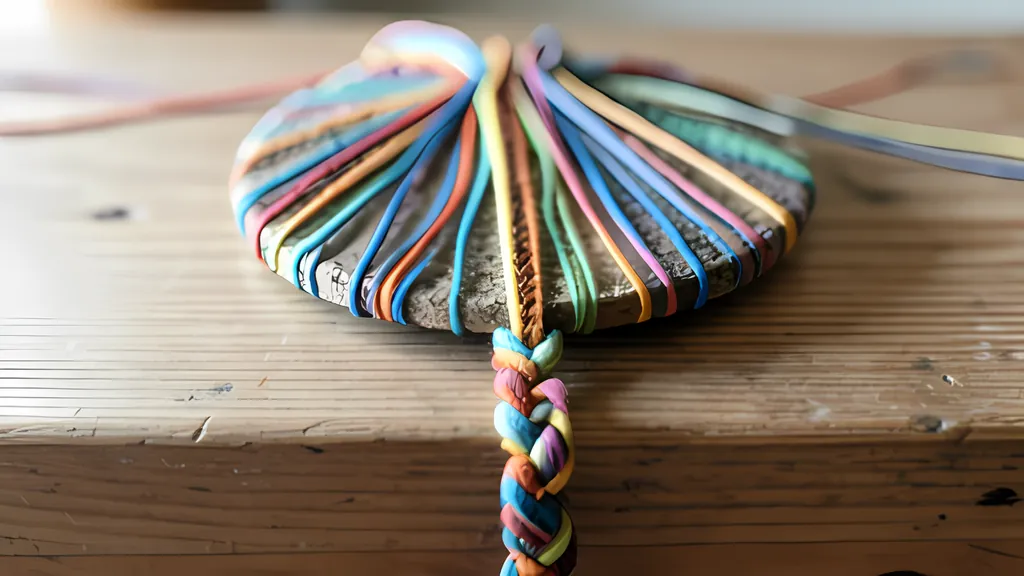
The foam disk is new by comparison. The same glossary says the original foam disk was developed and created by Makiko Tada in 2002. It is a light circle with numbered slots that grip the threads, so the tension that weights give on a marudai comes from friction instead. The usual disk has 32 slots. The disk is a narrower tool than the stand. The reference article on kumihimo points out that it limits the braider to 32 threads no thicker than a slot and cannot make flat braids. For the round braid, though, it does the whole job, and it fits in a pocket.
One move, repeated
Holden, writing for the Bridges conference in 2022, describes the braid most North American braiders start with, kongo gumi. It uses a number of strands divisible by four, traditionally sixteen, arranged in pairs spaced evenly around the disk. In his words, the upper-right strand becomes the new lower-right strand, and the lower-left strand becomes the new upper-left strand. Then the disk is turned and the same thing is done to the next pair.
Follow one strand and the spiral explains itself. Every strand is moved in the same rotational sense, half way round the braid each time, and then waits while the others take their turns. Each move lays one visible stitch. Because all the strands travel the same way, the stitches of any one color line up along a slant, and Holden notes that the braid cannot be its own mirror image.
On sixteen strands the bookkeeping is short. A step is two moves and a turn. After sixteen steps, which is 32 moves, every strand is back in its own pair and the whole arrangement has crept round the disk by one pair: the braid has completed one repeat. Tutorials differ in which hand moves first and which way the disk turns; reversing both gives the mirror image of the braid.
The pattern is in the starting order
Since the moves are fixed, the only free choice is the color of each strand, and the surface follows from it stitch by stitch. Holden’s figures show this directly: a disk with sixteen numbered strands beside a chart of the braid in which every stitch carries the number of the strand that made it. A craft site that photographs nine braids from the same eight cords in two colors makes the same point with thread.
Here is a worked example that can be reproduced. Take sixteen strands in four colors, A to D, and give both strands of each pair one color, going round A, B, C, D, A, B, C, D. Opposite pairs then match. The first two rows of the braid’s surface read A B C D A B C D, and the third reads B C D A B C D A. The colors form stripes that wind steeply around the cord, as in one of Holden’s figures.
The counting is where the mathematics earns its place. Neilson catalogued the two-color braids of sixteen strands by hand and found 1157. Holden counted them with a theorem of de Bruijn and got 1161, or 1,162 with the plain one-color braid included, and the two of them then tracked down the four that were missing. With up to four colors the count passes five million.
One consequence surprises people who use a planning tool for the first time. Turning the whole layout by one pair on the disk does not always give the same braid, because the moves begin at the top pair and the order in which pairs are worked is part of the structure. Shifting every color to the strand that follows it in the braid does give the same cord.
A large public library of charts for this braid, with over six thousand patterns for eight strands and many more, shows how far a single rule can be taken. The charts in it for 8, 12, 16, 20, 24 and 32 strands are a useful test for any simulation: run the moves, color the stitches, and the picture should match cell for cell.
Planning thread, and what planning cannot do
Thread length is the part of planning that is not exact. A widely repeated rule of thumb, stated in one beginner tutorial as cutting each cord to the finished length x 3, is a starting point and nothing more. As a formula it is 3 x the finished length, and a different tutorial suggests about 20 inches a strand for a bracelet.
A test sample is better. Cut one strand to a known length, braid a few centimeters, and measure both the braid and what is left of the strand. The strand used divided by the braid made is your own take-up ratio, for your thread and your hands. Then each strand is the finished length times that ratio, plus whatever you allow for knots and tails.
With the rule of thumb, a 20 cm braid needs 60 cm a strand; add 20 cm for knots and tails and each strand is 80 cm. Sixteen strands come to 12.8 m, and in the four-color example each color takes four strands, 3.2 m. Those are sums, not promises.
What a simulation gives is the order of the stitches, which is exact. What it cannot give is the look of the cord in the hand. Thick thread, thin thread, slippery silk and firm tension all change how much of each stitch shows and how steeply the stripes lie. A chart is a plan to braid from and to check against, and the first few centimeters of real cord are still the proof.
Sources
Every source consulted for this guide. Links checked October 5, 2026.
- Changing Spots: Using Combinatorics to Count Japanese Braiding Patterns The Bridges Archive (Joshua Holden, Bridges 2022)
- History of Kumihimo: Ancient Japanese Braiding Techniques JAPAN HOUSE Los Angeles
- Kumihimo: Japanese Silk Braiding by Domyo Japan House London
- Adachi Kumihimo Gallery The Kyoto Museums Association
- Iga Braided Cords (Iga Kumihimo) KOGEI JAPAN
- Kyo Braided Cords (Kyo Kumihimo) KOGEI JAPAN
- Kumihimo (Koo-mee-hee-moh) American Kumihimo Society
- Marudai (mah-roo-dye) American Kumihimo Society
- Disk (Disc) American Kumihimo Society
- About Kumihimo Orion's Plumage (Rosalie Neilson)
- Kumihimo Wikipedia
- How To Do Kumihimo: Basic Braid-Making Tutorial Create Whimsy
- 8 Strand Kumihimo Patterns by Color Placement Dream a Little Bigger
- Kumihimo Patterns friendship-bracelets.net