
The guide
Marbled paper is a record of where the ink was pushed, and none of it is ever lost
Every drop on a marbling tray shoves its neighbors aside without mixing into them. That one habit of floating color explains the old patterns, and it can be written down exactly.
- early 12th century the oldest suminagashi sheets a Japanese art dictionary can point to
- about 1600 when marbled paper began to be imported into Europe
- 15 to 30 mm tooth spacing of the first comb in a nonpareil
- 34.99 mm outer radius of a 30 mm drop after an 18 mm drop lands inside it
- 2014 ebru joins the UNESCO list of intangible heritage
Read the full guide Fold the guide
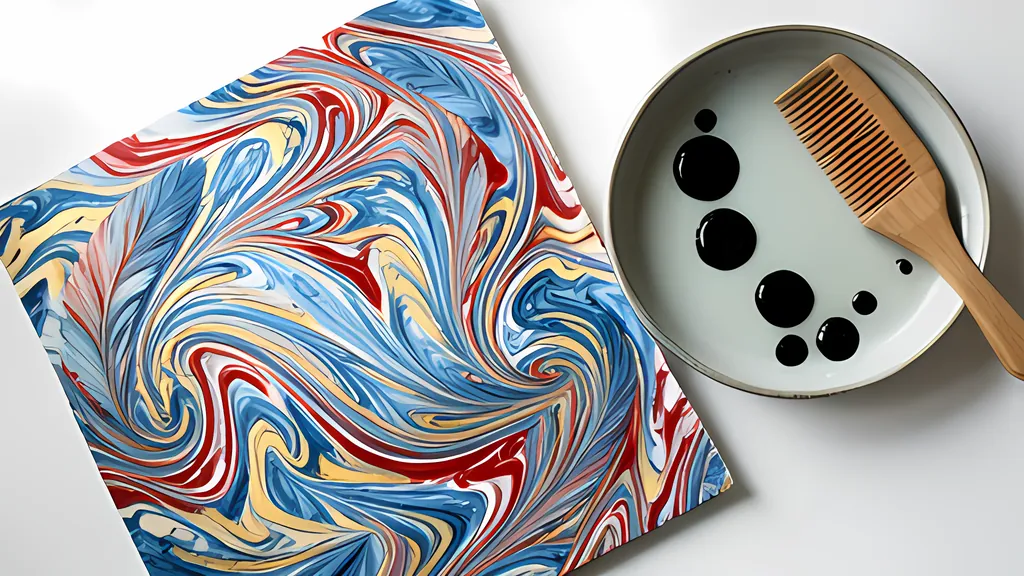
A marbled endpaper looks like a picture of turbulence. It is closer to a ledger. Each color on the sheet was once a round drop, and the sheet records, without loss, everything that happened to that drop afterwards: which later drops landed beside it, which comb crossed it, and in which direction.
That is why a pattern can be repeated at all. The surface does not forget and it does not blur. Colors lie side by side, and the pattern is whatever the pushing leaves behind.
Three traditions, one floating film
Nobody can say with confidence where the craft began. The University of Washington’s decorated paper collection calls the origins disputed, with early development claimed for China, Japan and the countries of the Middle East, and it attributes the Japanese form, suminagashi, to as early as the 10th century. Other reference works are more cautious. A dictionary of Japanese art terms hosted at Columbia University points to the oldest surviving example instead: an anthology of the early 12th century kept at Nishi Honganji in Kyoto. An Irish library’s exhibition notes give “approximately 1118”. The dates differ because the questions differ.
The Japanese method is the sparest. A few drops of ink are set on plain water and a sheet is laid on top. In the traditional way, the Washington essay explains, the ink is followed by a drop of surfactant made from tree resin, then ink again, so that rings form inside rings. The rings are then coaxed into wavy, moire-like lines with a stylus, or by fanning or blowing gently across the water. For more than 400 years, the same essay says, the technique was exclusive to the imperial house and the nobility.
Centuries later a related art appeared further west. The Washington collection places it in Turkey, where it is called ebru, and in Persian lands, where it was called abri, in the 15th century. Turkish sources tell a longer story of their own: the culture ministry describes first forms emerging in Central Asia in the 13th century and reaching Anatolia later, with Ottoman calligraphers and artists perfecting the techniques. The oldest written account of methods and materials that a Turkish cultural history can name is a treatise dated 1608.
Ebru is a living practice, not a museum piece. Turkey’s culture ministry records that it was registered in 2014 on UNESCO’s Representative List of the Intangible Cultural Heritage of Humanity, and describes colors mixed with a few drops of ox-gall and sprinkled or brushed onto a thickened liquid, where they float. Knowledge passes from master to apprentice, and the ministry notes that basic skill takes at least two years. It lists patterns that evolved over centuries, among them gelgit, tarakli and hatip.
Europe met the craft through trade. Travelers noticed the papers and began importing them about 1600, according to the Washington essay; a University of Minnesota librarian credits Venetian traders and puts production in France, Germany and Holland during the 17th century. Bookbinders used the sheets for endpapers and covers. Workshops guarded their recipes so closely that much was lost, and an apprentice might be taught only one or two patterns.
How a drop becomes a feather
The simplest Western pattern is thrown color and nothing else. The Washington collection lists it as Turkish, also called Spot, Stone or Agate, and dates it to the middle of the 15th century. Colors are thrown onto the bath with a brush. The first colors, squeezed by everything that lands after them, shrink into the thin veins that give the pattern its stony look.
Everything combed starts from that base. Draw a comb through the stones once in each direction, the second pass splitting the tracks of the first, and the round spots stretch into long opposed chevrons. Western pattern books file the result under names such as Zebra and Fountain, depending on what is sprinkled on afterwards.
The nonpareil, whose name is French for matchless, adds one more step. In the sequence the Washington collection gives after the marbler Einen Miura, a comb with teeth 15 to 30 mm apart is drawn across the bath once each way, and then a second comb with teeth only 2 to 3 mm apart is drawn once at right angles. The fine comb turns every stripe into a column of tiny arches. A conservation dictionary dates the nonpareil’s wide use to about 1838 and gives its classic colors as red, black, yellow, blue and buff.
From the nonpareil comes the bouquet, created near the end of the 18th century: a comb with two offset rows of teeth is drawn through in loose, wavy lines, and the arched columns fan out like bunches of flowers. Start the same motion from a twice-combed stone base and the result is the peacock. A single wavy pass with a wider comb gives the serpentine. Swirl a stylus in the bath and the stones curl into the French curl, or snail.
The names are not a settled vocabulary. The Washington essay warns that no text is accepted as the final authority and that most patterns carry several names. What is stable is the grammar underneath: a base of drops, then a short sequence of straight, wavy or circular strokes. Order matters. The last stroke is always the most visible.
Why the mathematics refuses to lose ink
Aubrey Jaffer, working with Shufang Lu, Xiaogang Jin and others, turned that grammar into formulas. His starting assumption is physical: if the tools move slowly, the layer of floating paint behaves as a two-dimensional fluid that cannot be compressed. Paint cannot pile up and cannot vanish. Any move a marbler makes must therefore carry each small patch of the surface to a new place with exactly the same area.
A drop is the clearest case. Suppose a spot of area a floats on the bath and a new drop of area b lands at its center. The covered area grows from a to a plus b, so the old edge must retreat from radius sqrt(a / pi) to sqrt((a + b) / pi). Jaffer’s rule for any point follows: a new drop of radius r at C moves a point P directly away from C, to C + (P - C) sqrt(1 + r^2 / d^2), where d is the distance from P to C. A ring of ink pushed outward this way becomes thinner, and its area does not change.
Here is a case to try. Put a drop of radius 30 mm on bare water: a disk of 2,827 square millimetres. Now add a drop of radius 18 mm at the same point. The first color is pushed into a ring whose inner radius is 18 mm and whose outer radius is the square root of 30 squared plus 18 squared, which is 34.99 mm. The ring is only 16.99 mm wide, yet its area is still 2,827 square millimetres.
A tine drawn in a straight line is a different kind of move with the same virtue. Points near the track are dragged along it; points far away barely stir. Because every point slides parallel to the track, by an amount that depends only on its distance from the track, whole sheets of fluid slip past each other like cards in a deck. Nothing is squeezed. A wavy stroke is a straight one seen through a sideways sine displacement, and a swirl turns each circle about its center by its own angle.
These moves share a second property that matters as much as the first. Each one can be run backward exactly: a straight stroke is undone by the same stroke with its pull reversed, a turn by the opposite turn. So the color at any point of the finished sheet can be found by walking that point back through the strokes, last to first, until it lands inside one of the original drops. Jaffer calls this marbling backward.
Sharpness follows from that. No picture is stored between steps, so nothing accumulates: a hundredth stroke is computed as cleanly as the first. Jaffer’s papers contrast this with finite-element fluid solvers, which are orders of magnitude slower. The boundary between two colors is a mathematical curve, not a row of pixels, and it can be drawn at any size.
What the formulas leave out
A real tray is not an unbounded plane of ideal fluid. The formulas assume slow strokes in a thick bath. Jaffer’s own experiments show what happens otherwise: with thinner size, drawn rakes shed vortices and mushroom shapes appear inside mushroom shapes. He also reports that true vortices are rare in practice, because the bath is normally far too viscous for them.
The chemistry is absent too. Marblers describe a temperamental process that changes with temperature, humidity, paper, the quality of the colors, the thickness of the size, shaky hands and even dust. Paper must be treated with alum or the pattern rinses away. Each pigment spreads differently, and a dispersant such as ox-gall changes how far. Several historic patterns depend on such reactions: oil that leaves a pale halo around each spot, or turpentine that opens a lacework of holes. None of that is in an area-preserving map.
Nor is the hand. The Spanish pattern is made at the last moment, by rocking the sheet as it is laid down, and marbling lore credits it to an assistant with a hangover. A formula for combing has nothing to say about how paper meets water.
So a computed sheet is best read as a diagram of the craft, drawn with perfect ink. It shows which strokes make which pattern, and why the order cannot be swapped. It makes one promise the tray also keeps: every drop that went in is still there, somewhere, at its full size. What it cannot give is the part of marbling that people spend at least two years learning.
Sources
Every source consulted for this guide. Links checked October 5, 2026.
- Essay: Marbled Papers University of Washington Libraries, Decorated and Decorative Paper Collection
- Paper Patterns University of Washington Libraries, Decorated and Decorative Paper Collection
- suminagashi 墨流し JAANUS, hosted by the Media Center for Art History, Columbia University
- Ebru: Turkish Art of Marbling Ministry of Culture and Tourism of Turkiye (yakegm.ktb.gov.tr)
- THE TURKISH ART OF MARBLING (EBRU) Turkish Culture Portal
- Hidden beauty in ordinary books: Part 1 Laurie Jedamus, University of Minnesota Libraries News and Events
- Hidden beauty in ordinary books: Part 2 Laurie Jedamus, University of Minnesota Libraries News and Events
- Paper Marbling Emma Hassard, Armagh Robinson Library
- nonpareil marble Etherington and Roberts, Bookbinding and the Conservation of Books: A Dictionary of Descriptive Terminology, Conservation OnLine
- Mathematical Marbling Aubrey Jaffer
- The Mathematics of Marbling Aubrey Jaffer
- Dropping Paint Aubrey Jaffer
- Serpentine Marbling Aubrey Jaffer
- Scallop and Clam Shells Aubrey Jaffer
- Mathematical Marbling How-To Aubrey Jaffer
- Oseen Flow in Paint Marbling Aubrey Jaffer, arXiv:1702.02106
- The Lamb-Oseen Vortex and Paint Marbling Aubrey G. Jaffer, arXiv:1810.04646