The guide
A lithophane is a photograph stored as thickness, and the light does the developing
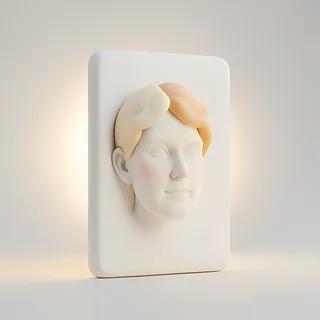
Porcelain makers worked it out in the 1820s: vary how much material the light must cross, and a blank white plaque turns into a picture.
- 1827 year the porcelain technique was patented in France
- 0.8 to 3.0 mm a span inside one maker's ranges for white PLA
- 0.12 mm layer height one maker's guide and one study both settle on
- 1.24 g/cm3 density of PLA on one maker's data sheet
- 60 C where PLA goes soft, so the lamp must run cool
Read the full guide Fold the guide
Hold a porcelain lithophane in ordinary room light and you are holding a lumpy white tile. Put a candle behind it and a face looks back. Nothing was painted on. The picture is stored as thickness.
The trick has an inventor and a date. Baron Paul de Bourgoing, a French diplomat, patented it in 1827, and the earliest examples were made at the pottery his friend Baron Alexis du Tremblay kept on his estate at Rubelles. De Bourgoing thought trade unsuitable for a diplomat, so the plaques carry his friend’s initials instead of his own: AdT. Other factories took the method up quickly, many under licence. Meissen made lithophanes from 1829 and had turned out tens of thousands by 1850. An encyclopedia entry gives the whole idea in a sentence: the plaque is moulded to varying thickness, so that when it is lit from behind the different thicknesses show as different shades.
The original method was a kind of drawing with the light already switched on. A slab of wax was laid on glass and carved with small tools while light came through from behind, so the carver watched the picture develop as the wax thinned. A plaster cast of the finished wax became the mould, porcelain went into it, and the kiln did the rest. The kiln was unkind. With the porcelain in places only about 1/8 inch thick, up to about 60 percent of the pieces were lost in firing.
They sold anyway. Production peaked from about 1840 to 1870, with the royal porcelain works in Berlin the largest of the makers, and the plaques went into lampshades, night lights and window hangings. They were small things: the longest side of a typical plaque is between 6 and 10 inches. A collector in Toledo, Ohio, Laurel Blair, gathered more than 2,300 lithophanes, and his collection is now shown at Schedel Arboretum and Gardens. The name is Greek for stone made to appear. The museum admits that this is confusing, since no stone is involved.
Two entries in the Science Museum Group’s catalogue show what the buyers took home. One is a night light made in Europe between 1871 and 1920: a holder of black painted tin with a gilt design, about 15 cm tall, whose porcelain shade shows mothers and children once a candle is set inside. The catalogue says such lights comforted children afraid of the dark and were sometimes used in hospital wards for children. The other is a plated tin lamp with a four-sided frame. Each side holds a lithophane picture 2.5 by 3.5 cm, among them a girl with flowers and a girl reading outside.
Why thickness becomes brightness
A lithophane works because a translucent material dims light according to how much of it the light must cross. More material, less light. That much is obvious. The exact rule is less obvious, and it decides how a photograph ought to be translated into a solid.
Chemists know the rule as the Beer-Lambert law, usually met in a laboratory, where a beam crosses a glass cell of colored liquid. It says that absorbance, the logarithm of the light going in over the light coming out, is directly proportional to the length of the path. Put plainly, every equal slice of material removes the same fraction of whatever light reaches it. If the first half millimeter passes half the light, the next half millimeter passes half of that half. Light through a wall therefore does not fall along a straight line as the wall thickens. It falls by repeated halving: a half, a quarter, an eighth, a sixteenth.
The simplest translation ignores this and draws a straight line anyway. White pixels get the thinnest plastic, black pixels the thickest, and every gray lands in proportion between them. Take a panel that runs from 0.8 to 3.0 mm and a middle gray of 128 on the usual scale of 0 to 255. The straight line puts that gray at 1.90 mm, which is 1.10 mm more than the thinnest spot. Suppose, purely for the arithmetic, that 0.5 mm of this plastic halves the light. Then the gray passes about 22 percent of what the thinnest spot passes, and black passes about one part in 21.
That is a better result than the crude method deserves. A screen does not treat gray values as equal steps of light either. The sRGB color space that the web is built on was designed around displays with a gamma of 2.2, and under its formula a gray of 128 emits about 22 percent of the luminance of white. Straight-line thickness in a material that halves and halves again happens to bend the same way. The match is rough, and it is an accident of the numbers chosen. With a different plastic it would vanish.
The alternative is to solve the halving rule backwards. Decide what share of the light each pixel should pass, then take a logarithm to find the thickness that passes it. On paper, the light then follows the photograph exactly.
On paper is the honest phrase. The law was written for clear liquids, and a print is a stack of pale layers. An encyclopedia entry on the law notes that it tends to break down in a material that scatters strongly, which white plastic does by design. American Filament’s table of limits differs between its whites, its grays and its sepia, so even pale filaments do not behave alike. Any preview on a screen is a model of the idea and not a forecast of the print.
Even one spool is not a fixed quantity. A study published in 2024 printed samples 1 mm thick from a single transparent PLA and measured, with a light meter in an integrating sphere, how well each let light through. By its measure the slicer’s default settings reached 65 percent and the best combination of position, layer height, temperature, cooling and flow reached 88 percent.
Choosing the numbers
Thickness limits come from the filament, so the most useful figures come from people who sell filament for this exact job. American Filament’s guide lists, for its classic white PLA, a thinnest wall of 0.7 to 0.9 mm and a thickest of 2.8 to 3.1 mm, with slightly different pairs for one of its grays and for its sepia. A span of 0.8 to 3.0 mm sits inside both ranges and is a fair place to start. The advice on what to do next is blunt: print a test, and if it looks too dark or too washed out, stop and try again with different limits.
One university study did exactly that. Two researchers at the University of Ljubljana printed the same picture with the thinnest part of the tile at 0.5, 1.0 and 2.0 mm. The 0.5 mm tile passed the most light and printed fastest, but it was too thin for their printer and showed artifacts. The 2.0 mm tile let too little light through and turned yellowish. They chose 1.0 mm.
Resolution is the spacing of the samples. The same guide suggests 0.1 to 0.25, a figure the generator it was written for defines as millimeters between pixels in the printed part, and it warns that the fine end swells the file. That is four to ten samples per millimeter. Finer is not automatically better. American Filament calls the 0.4 mm nozzle the most commonly used and sets a line width of 0.45 mm for it, so a feature much narrower than that cannot be drawn however densely the model is sampled. In the other direction the limit is the layer height, which the translucency study names as the main factor in vertical resolution.
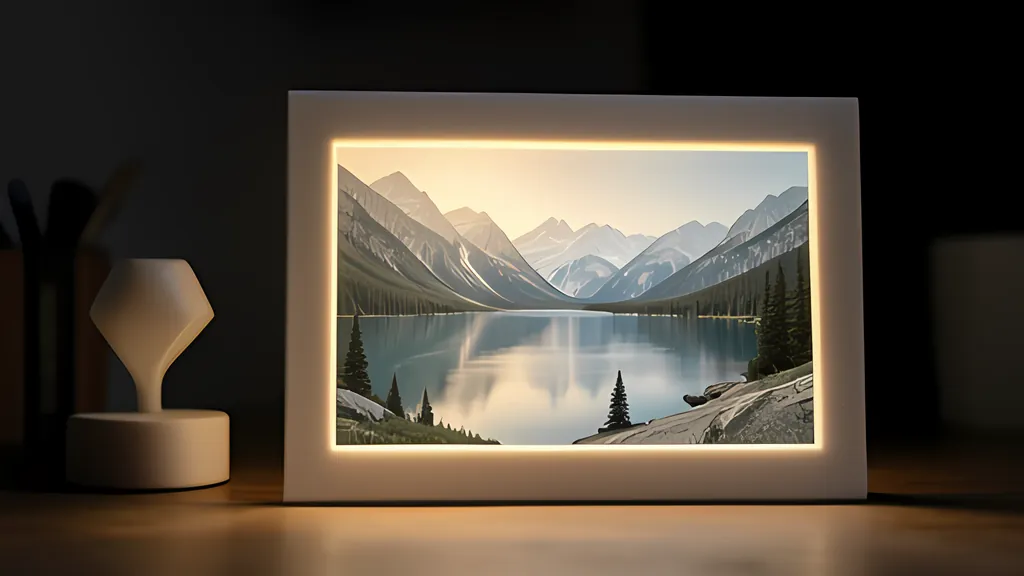
A worked case makes the cost visible. Take a flat panel 100 mm wide with a 3 mm frame, plastic from 0.8 to 3.0 mm and four samples per millimeter, built from a picture in the proportion 4 to 3. The picture area is 94 by 70.5 mm, so the panel stands 76.5 mm tall. The grid is 376 by 282 cells, and the finished mesh has 218,674 triangles in a file of 10.4 MB. For a sample picture of a sun over a mountain lake, a generator given those values reports a solid volume of 16.6 cubic centimeters. One PLA data sheet gives a density of 1.24 g/cm3, so the panel weighs about 20.6 g.
That file is an STL, a format the Library of Congress traces to 3D Systems in 1988. It holds nothing but triangles, each listed counterclockwise as seen from outside, each sharing its edges with its neighbors.
Standing up, and why
The generators built for this job assume the panel is printed standing on its edge. Lithophane Maker’s flat tool has a setting for the overhang that appears, in its words, when you print the lithophane vertically, and one of its frame options is a printing stand. The arithmetic gives the reason. Lying flat, the relief is built from layers, and 2.2 mm of relief at a layer height of 0.12 mm is 18 layers, which means 18 shades of gray and no more. Standing, the same relief is drawn sideways by the path of the nozzle, and the layers stack up the picture instead, 637 of them in a panel 76.5 mm tall.
The Ljubljana study tested the choice directly. It printed its tile both lying down and upright and recommended upright for an accurate reproduction, calling the differences significant. Of all the settings it compared, the position during printing changed the picture most.
Standing has a cost, and it is worth knowing. A tall thin part can wobble as it grows, and a panel lying flat on the bed cannot, which is why a generator may offer both positions. American Filament names the enemy. Wobbling shifts layers, it says, and in a lithophane the shift is very noticeable. Its guide suggests a brim against warping at the base and, on a printer whose bed moves, lining the panel up along the Y axis.
The settings that matter are few. American Filament’s table pairs a 0.4 mm nozzle with a layer height of 0.12 mm. The Ljubljana study tried 0.12, 0.20 and 0.28 mm and kept 0.12, because the two coarser settings left visible layers in the picture. The picture area must be solid, and that study printed every sample at 100 percent infill. Having tested 99 percent infill, 100 percent infill and thick walls and seen no difference, the same guide settles on at least seven walls. And it pays to go slowly on the surface: its starting figure for the outer wall on an ordinary printer is 30 mm/s.
Plastic, color and the lamp behind it
White is the default. An encyclopedia entry names white PLA as the standard filament for a printed lithophane, and American Filament’s lithophane range runs to two whites, two grays and a sepia. The Ljubljana authors chose white because a lithophane must transmit light, and they warn that a transparent filament would not separate the dark parts of the picture from the light ones. The result is a black and white photograph. Color needs other tricks, such as a printed transparency behind the panel or layers of translucent cyan, magenta, yellow and black plastic, which is a different craft with its own rules.
The lamp matters as much as the plastic. PLA has a glass transition at 60 to 65 C, the point where a rigid plastic turns soft, and one maker’s data sheet puts its heat distortion temperature at 55 C. An incandescent bulb releases 90 percent of its energy as heat, according to ENERGY STAR, which makes it the wrong neighbor for a thin plastic shell. An LED makes its light far more efficiently and sends it in one direction. American Filament recommends a cool white backlight for its own filaments, and the Ljubljana study preferred a neutral white LED to a halogen lamp, which tinted the picture orange and ran hot. A window works too.
What the method cannot do
A lithophane cannot rescue a weak photograph. It has only the gap between its thinnest and thickest plastic to work with, so a picture that is all midtones uses a sliver of that gap and comes out as fog. American Filament’s advice is to choose a picture that is neither too light nor too dark and has good contrast.
Nor can it hold detail finer than the machine. A hair one tenth of a millimeter wide in the model is narrower than the line the nozzle lays down. Raising the resolution past that point buys a larger file and nothing else.
And no generator can say how bright the finished piece will be. That depends on the spool, on the light behind it and on the room around it. The porcelain makers had the honest method, which was to carve with the light already on. The modern equivalent is a small test print held up to the lamp it will live with.
Two centuries on, the object has changed from fired clay to extruded plastic, and the idea has not changed at all. A picture can be kept as nothing but thickness. The light does the developing.
Sources
Every source consulted for this guide. Links checked October 4, 2026.
- Lithophane - Wikipedia Wikipedia
- What is a Lithophane? - Schedel Arboretum and Gardens Schedel Arboretum and Gardens, Blair Museum of Lithophanes
- Blair Museum History - Schedel Arboretum and Gardens Schedel Arboretum and Gardens, Blair Museum of Lithophanes
- Night light, Europe, 1871-1920 | Science Museum Group Collection Science Museum Group
- Nightlight with lithophane pictures | Science Museum Group Collection Science Museum Group
- Beer-Lambert law - Wikipedia Wikipedia
- Relative luminance - WCAG WG W3C Web Accessibility Initiative, working group wiki
- A Standard Default Color Space for the Internet - sRGB W3C; Michael Stokes, Matthew Anderson, Srinivasan Chandrasekar and Ricardo Motta, 1996
- sRGB - Wikipedia Wikipedia
- Beginner's Guide to Printing Lithophanes - from Lithophane Maker! - American Filament American Filament, Megan Brooks, updated 19 November 2024
- Flat Lithophane Maker Lithophane Maker
- 3D Printed Lithophane Jure Klokocovnik and Deja Muck, University of Ljubljana; GRID 2022 proceedings, University of Novi Sad, Faculty of Technical Sciences
- Fused Filament Fabrication 3D Printing Parameters Affecting the Translucency of Polylactic Acid Parts Vochozka and others, Polymers (Basel), 2024, via PubMed Central
- Polylactic acid - Wikipedia Wikipedia
- Technical Data Sheet: The Filament PLA Spectrum Filaments
- Learn About LED Lighting | ENERGY STAR ENERGY STAR, U.S. Environmental Protection Agency
- STL (STereoLithography) File Format Family Library of Congress, Sustainability of Digital Formats