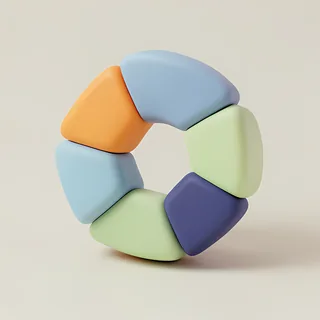
The guide
A Kaleidocycle Turns Forever Because Six Paper Pyramids Leave It Exactly One Way to Move
A ring of hinged tetrahedra ought to be stuck, or floppy. Six of the right shape are neither: they roll through their own middle without end, and show four pictures as they go.
- 6 tetrahedra hinged edge to edge in the classic ring
- 24 triangles in the net: four pictures of six
- 1.118 leg over base when the middle closes
- 1929 Paul Schatz finds the invertible cube
- 80 mm ring across, from 40 mm triangles
Read the full guide Fold the guide
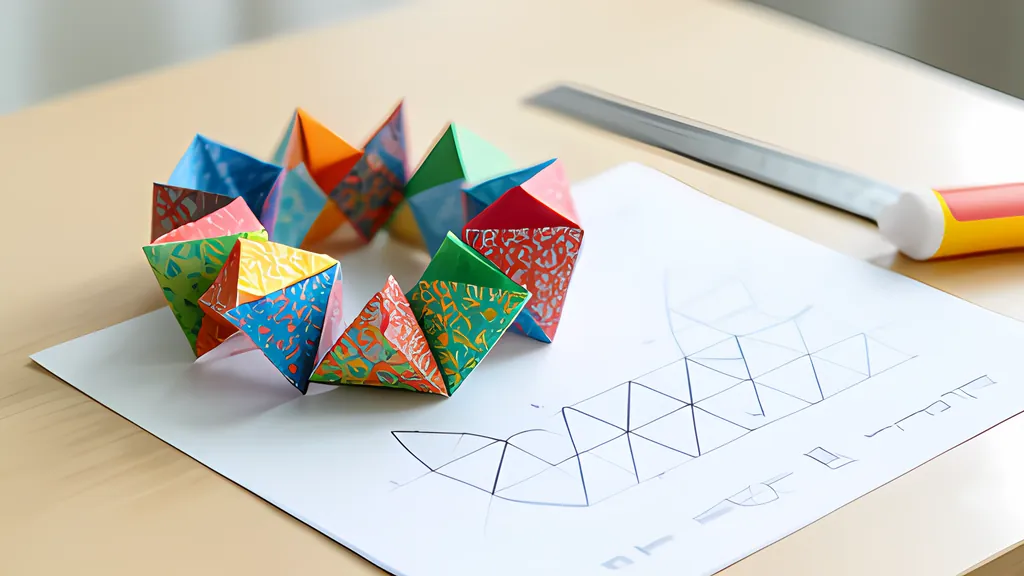
A kaleidocycle is a paper ring that you can turn inside out and never reach the end of the turning. Push its outer corners down and in, and the ring rolls through its own middle like a bubble ring, showing a new face at every quarter turn.
It is built from 6 tetrahedra, small pyramids with four triangular sides, joined to each other edge to edge. There is no axle and no elastic. Making one takes a sheet of paper, scissors and glue. The better question is why a closed chain of rigid solids moves at all, and why it moves in only one way.
A ring that ought to be stuck
Pick two edges of a tetrahedron that do not touch. In a kaleidocycle those two edges are the hinges, and they lie at right angles to each other. Each tetrahedron hangs from one neighbour by the first edge and from the next by the second, so the ring is a loop of six solids and six hinges that alternate in direction.
Count freedoms the way an engineer would and the loop should be rigid. Physics World, reporting on work by Johannes Schönke and Eliot Fried, describes exactly that count: take the freedoms of the corners, subtract what the edges fix, remove the six ways any rigid body can shift and spin, and the classic sixfold ring is left with no internal freedom at all. Yet it turns. Their word for it is overconstrained, a mechanism whose high symmetry allows one hidden degree of freedom. That single freedom is the everting motion, the roll through the middle, and the ring has no other.
One freedom is what makes the toy feel so definite in the hand. Herbert Kociemba, who has worked out which tetrahedra can form such rings, puts it plainly: you can rotate the ring inside out, but it does not wiggle otherwise. Add two more tetrahedra and that changes. The same Physics World report gives an eightfold ring two internal freedoms, so a bigger ring can be bent out of shape as well as turned.
And nothing winds up. The shape of the ring repeats after every quarter turn, and after four quarter turns every corner is back exactly where it began. There is no twist left over to undo, so the fifth quarter turn is the first one again.
Found three times before it had a name
The object is older than its name. A recent mathematical paper on kaleidocycles calls their origin obscure and traces one of the first appearances to the kinematics lectures of the French mathematician Raoul Bricard, published in the 1920s, which treat an equivalent closed chain of six hinged links. Engineers still call that chain the Bricard linkage. A German survey of such models credits Bricard as the first to state the general conditions under which a six-link chain with turning joints can move.
Paul Schatz found a special case independently in 1929. Schatz, a sculptor and inventor who lived from 1898 to 1979, cut a cube so that a belt of six pieces could be turned inside out without end. The University of Bremen’s mathematical collection keeps the date and the model, and notes that the oloid, a rolling solid he is also known for, comes from the surface a diagonal of that belt sweeps out. Accounts of kaleidocycles now list the invertible cube as one more of them, the one whose triangles have a right angle.
The paper version came from a designer. Wallace Walker, an American graphic designer, was working on structural forms for paper in 1958 when he found a net of isosceles triangles that folded into a ring able to turn through itself. He applied for a United States patent on 16 August 1963; it was granted on 7 February 1967 under the title “Foldable structure”. The patent calls the thing an amusement device in the nature of a kaleidoscope and suggests printing illustrations or advertising on its panels. Walker coined the word kaleidocycle from the Greek for beautiful, form and ring.
Doris Schattschneider, a mathematician at Moravian College, turned the idea into the form most people know. In 1977 she and Walker published a book of models to assemble, covered in the interlocking patterns of M. C. Escher. A later review in the Los Angeles Times counted 17 models in the set and pointed to the hard part: the patterns had to be placed so that they stayed continuous however the shapes were turned.
The proof that such rings always exist is recent. The paper mentioned above, first posted in 2023, gives explicit formulas for the motion and shows that kaleidocycles exist for any number of tetrahedra greater than five.
Why the triangles are not equilateral
The obvious ring does not work. Six regular tetrahedra, with every edge the same length, can be hinged into a loop, but the loop jams: the solids collide in the middle before it has turned all the way. M. Engel’s short account of the theory shows that regular tetrahedra need at least eight in the ring. For six, the tetrahedra have to be stretched.
How far is a matter of one inequality. Engel places a single tetrahedron between two planes that meet along the ring’s axis, with one hinge in each plane, and builds the rest of the ring by mirroring. For six tetrahedra the planes are 60 degrees apart. The ring can turn completely only if half a hinge is no longer than the distance between the two hinges divided by the tangent of that angle. Rewritten for the paper triangle, that says the altitude must be at least the base divided by twice the cosine of 60 degrees, which is the base itself. Shorter triangles collide; taller ones leave a hole.
At the limit the hole shuts to a point four times in every full turn, and that is the classic model: triangles exactly as tall as they are wide, with legs the square root of five over two, about 1.118, times the base. Jürgen Köller gives the same proportion for the closed ring of six, as a ratio of 1.12 to 1.
A worked example makes the sizes concrete. Choose a base of 40 mm. Each leg is then 44.7 mm and each triangle is 40 mm tall. The net is six columns of triangles, so it is 240 mm long, and it is two and a half bases, 100 mm, tall before the glue tabs are added. That fits a sheet of A4 turned on its side. Folded and closed, the ring measures 80 mm from corner to corner. On A4 the base can grow to 43.8 mm before the net runs into the margins, and on Letter to 41.0 mm.
Proportions quoted from a page are easy to get wrong, so the tool on this page does not take them on trust. It folds the net in arithmetic, as rigid triangles on hinges, bends the chain round, and measures the gap where the two ends meet. With these proportions the gap is zero to within rounding, and every edge keeps its length at each of 720 positions round the turn.
Four pictures on 24 triangles
Six tetrahedra have 24 triangles between them, and the turning ring sorts them into four sets of six. At each quarter turn one set faces up around the middle while the others are on the rim, underneath, or folded face to face inside. In the flat net the sets are simply the four rows. A drawing on Wikimedia Commons colors them that way, and the fold simulation here reaches the same grouping on its own before the two are compared.
Seen from directly above at a quarter turn, the six triangles of the upper set fill a regular hexagon. They are not flat. The hexagon is a shallow star with three ridges and three valleys, and its corners sit alternately at two heights half a base apart. Each triangle therefore appears as a sixth of the hexagon, a 60 degree wedge, although on paper it is taller than that. Putting a picture on the ring means cutting the picture’s hexagon into six wedges and stretching each one onto its triangle, turned to match. On the flat net the pieces look distorted and shuffled. On the ring, from above, they close up.
That is also the limit of the method. A picture is whole only at its own quarter turn and only from above. Turn the ring over at that moment and the underside shows the triangles of the picture two steps away, but arranged around the wrong corner, so it reads as a scramble. Between quarter turns two pictures are each half visible. A crease runs through the middle of every picture, which is hard on small text and faces.
Schattschneider’s Escher models solve a harder problem than this one, because a repeating pattern can be made to join across every hinge in every position. Four separate photographs cannot. They can only take turns.
Scoring, folding and gluing
Paper has a grain, the direction in which most of its fibers lie, and a paper maker’s guidance on folding applies directly. Monadnock Paper Mills notes that a fold along the grain is smoother, that thicker sheets crack unless they are scored first, and that the sheet should be folded so the scored groove ends up on the outside of the fold. A net of this kind has creases in three directions, so some will always cross the grain. Score all of them.
The two kinds of line fold opposite ways. The slanted lines are mountain folds, creased back away from the print, and they roll each column of four triangles into one tetrahedron. The upright lines are valley folds and become the hinges. Glue the long row of tabs first. The net is then a straight chain of six tetrahedra joined edge to edge, and bending it round to glue the last two tabs closes the ring.
Keep glue off the hinge lines, and let it dry before the first turn. Real paper has thickness that the geometry ignores, so the middle of a closed ring is a little tight; ease it through a few times and the creases learn the motion.
After that it simply goes on turning. Six pyramids, one freedom, four pictures, and no last turn.
Sources
Every source consulted for this guide. Links checked October 6, 2026.
- M.C.Escher Kaleidocycles M. Engel, 2003, hosted by the Plueckthun Lab, University of Zurich
- Kaleidocycles Jürgen Köller, Mathematische Basteleien
- An explicit construction of Kaleidocycles by elliptic theta functions Shizuo Kaji, Kenji Kajiwara and Shota Shigetomi, arXiv 2308.04977
- Twisted linkage geometries hint at new organic chemistry Physics World, IOP Publishing
- Kaleidocycles - Introduction Herbert Kociemba
- Umstülpung: Geometrie in Bewegung Alexander Heinz, 5. Tagung der DGfGG 2009, hosted by the Institute of Geometry, TU Graz
- Oloid - Universität Bremen University of Bremen, Analysis and its Applications, mathematical collection
- US3302321A - Foldable structure Google Patents
- Book Review : Art Meets Math in 'Kaleidocycles' Los Angeles Times, 27 May 1988
- File:Kaleidocycle6 net.png Tomruen, Wikimedia Commons
- That Perfect Fold Monadnock Paper Mills
- Kaleidocycle Wikipedia