The guide
A Pop-Up Card Works Because Paper Can Only Move One Way, and the Fold Lines Decide Which
Open the card and a staircase stands up; close it and everything lies flat again. That is not luck or patience. It is a parallelogram, and it can be checked before any paper is cut.
- 0 to 180 degrees the opening angle, the card's only freedom
- 24 + 46 = 70 mm closed reach of the worked step, on a 105 mm page
- 70.5 degrees crease of a 45 and 45 V-fold when the card is at 90
- around 1765 Robert Sayer's lift-the-flap Harlequinades
- 1878 Meggendorfer's first movable, Living Pictures
Read the full guide Fold the guide
A pop-up card looks like a small act of generosity from the paper. You open the cover and a cake, a staircase or a row of buildings stands up without being asked. You close it and the whole scene lies down again, thinner than a coin.
Nothing in it is springy. Paper panels are stiff, the folds between them are hinges, and the card has exactly one thing it can do: open or close. Everything else in the design must follow from that single motion, or the card jams, tears, or leaves a corner poking out of the envelope.
So the interesting question is not how to make paper stand up. It is how to make paper that has no choice.
One angle and nothing else
Call the angle between the two pages the opening angle. It runs from 0 to 180 degrees, from shut to flat on the table. Researchers who study pop-ups describe a good one as a linkage with a single degree of freedom: rigid flat pieces, joined at hinges, whose position is fixed completely once that one angle is known. A team from MIT, Waterloo, Tufts and elsewhere proved in 2013 that any simple polygon can be built as such a linkage, flattening without collision as the card closes.
A second group, at Tsinghua University and Washington University in St. Louis, wrote down what a maker wants in plainer terms. The structure must close flat while every patch of paper stays rigid. It must need no force beyond holding the two pages. Nothing may pass through anything else on the way. And the closed result must sit inside the page border.
Those four demands are a useful checklist, because each one corresponds to a way real cards fail. A card that will not shut has a patch that would need to stretch. A card that needs a poke has more than one way to move. A card that crumples has two pieces trying to share a space. A card with a ragged edge has something sticking out.
The paper parallelogram
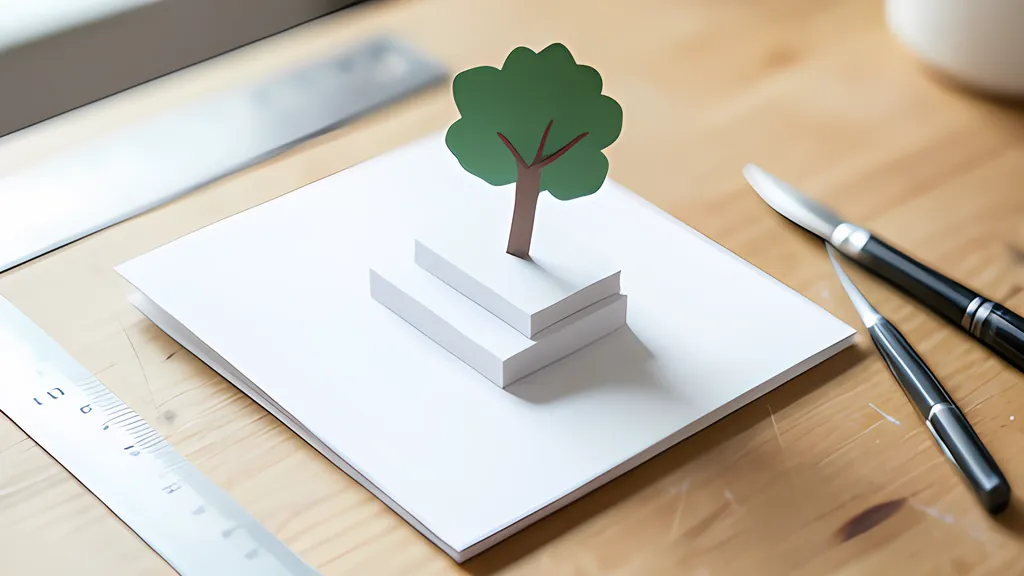
The simplest pop-up needs no glue. Make two parallel cuts across the centre fold, then crease the strip between them three times, parallel to the fold: once on the back page, once on the front page, and once in between. Push the strip forward and it becomes a step, with a level top called the tread and an upright front called the riser.
Look at the card from the side and the step is four points joined by four stiff bars: the centre fold, the crease on the back page, the new crease in the middle, and the crease on the front page. Suppose the back crease is a millimeters from the centre fold and the front crease is b. When the card is shut, the two pages lie together, so those two creases sit on one line, a and b from the fold. The middle crease can only lie on that same line if the tread and the riser differ in length by exactly as much as a and b do.
The strip was cut from the card, so tread plus riser must also equal a plus b. Two equations, two answers. One is dull: the middle crease stays on the old centre fold and nothing pops. The other is the whole trick. The riser equals a, and the tread equals b: a = riser, b = tread. The two distances swap sides, and the four bars form a parallelogram.
A parallelogram is the one four-sided linkage whose opposite sides stay parallel however it leans. The tread stays parallel to the front page and the riser to the back page at every angle. Shut the card and the parallelogram collapses onto a line. Open it flat and it collapses the other way, back into the sheet it was cut from. The 2013 paper states the same thing for a general four-bar pop-up: it folds flat outward when the two sides meeting at the crease on one page add up to the same length as the two on the other.
The rule also explains the cards that go wrong. Make the riser one millimeter taller than a and the bars can no longer reach a straight line: the card stops short of closing, or the paper buckles to make up the difference. Make it one millimeter shorter and the step closes into a shallow tent instead of lying flat.
Take an A6 card, which is an A5 sheet of 148 by 210 mm folded once, so each page is 105 mm deep. Cut a step 80 mm wide with a riser of 24 mm and a tread of 46 mm. The rule puts the back crease 24 mm above the centre fold and the front crease 46 mm below it. The middle crease, a mountain fold, lands 22 mm below the centre fold, since 24 minus 46 is minus 22.
Now close it in your head. The riser lies on the front page beyond its crease, so the far edge of the step reaches 24 + 46 = 70 mm from the spine. The page is 105 mm deep, so it stays inside with 35 mm to spare. A riser of 60 mm with the same tread would reach 106 mm and peek out of the closed card by a millimeter. That sum, riser plus tread, is the number to watch.
Each step also makes two new valley folds: one where its tread meets the back page and one where its riser meets the front page. Both open by the same angle as the card itself. So a second step can be cut across either, under the same rule, and a third across that. Stack them on the back folds and you get the tiers of a cake. Run them down the front folds and you get a staircase. Researchers call this family parallel paper architecture, because every piece stays parallel to one page or the other. It is also known as origamic architecture, and it is usually cut from a single sheet of card stock.
The other family: glued on
The second family adds separate pieces of paper. A glued strip behaves like the cut step, with one new freedom: its length is no longer tied to the sheet. Give both panels the same extra length beyond a and b and the flat-folding condition still holds, but now the strip is too long to lie down when the card is opened flat. It stands as a tent at 180 degrees, where a cut step has vanished.
The V-fold is the mechanism most pop-up books lean on. A folded piece is glued across the centre fold so that its own crease meets the fold at a point. Its two glue lines leave that point at the same angle to the fold, one on each page, and each wing spans some angle between its glue line and the crease.
Closed, both wings lie flat on their pages, and the crease must be in one place, so the two wings need the same angle. Open the card and the crease swings up in the plane that bisects the pages. A short calculation shows it can follow the card all the way to flat only if the wing angle is at least the glue angle. The Tsinghua paper gives an equivalent angle condition for the general case. With both angles at 45 degrees, the crease stands 70.5 degrees above the fold when the card is at a right angle and lies down again at 180.
Five centuries of flaps before the first pop
Movable books are far older than the pop-up. The Library of Congress traces them to the thirteenth century, to the monk Matthew Paris and the Catalan mystic Ramon Llull, both of whom used volvelles, rotating paper discs, to calculate dates and lay out ideas. They were for scholars, not children. The University of North Texas Libraries point to Andreas Vesalius, whose anatomical Epitome of 1543 showed the body in seven superimposed layers of lifted flaps.
Children came later. The same library records that around 1765 the London bookseller Robert Sayer began selling lift-the-flap books he called Harlequinades. In Munich, Lothar Meggendorfer made his first movable, Living Pictures, in 1878 as a Christmas present for his son, and went on to engineer as many as two hundred, driven by levers behind a single pull tab.
Which book first truly popped is a matter the libraries describe differently. The Library of Congress names a Little Red Riding Hood published by Dean and Son in 1855, whose layered scene rose when a ribbon was pulled. Miami University’s special collections credit Ernest Nister and Meggendorfer. Both accounts agree that S. Louis Giraud, in London in the 1930s, made scenes that rose on their own as a double page opened and could be viewed from several sides, and the North Texas exhibit adds that the publisher Blue Ribbon was the first to market books under the word pop-up.
Scoring, cutting and gluing cleanly
Geometry gets the lines in the right place. Craft gets the paper to obey them. Paper has a grain, the direction its fibers mostly lie, and a paper mill’s guidance is blunt about it: a fold along the grain is smoother than one across it, and heavy stock should be scored before it is folded or it will crack. For a card, that means pressing a groove along every fold line with a blunt point and a ruler before cutting anything.
Cut second. A craft knife is the right tool and a hazardous one. The UK Health and Safety Executive notes that knife injuries usually happen when the blade slips, most often into the other hand, and that blunt blades are a danger of their own. Cut on a mat, away from the hand that holds the ruler, with every finger behind the edge, and change the blade when it drags.
Glue last, and let the card do the measuring. Stick a glued piece to one page, put glue on its second tab, and close the card over it. The piece finds the only position in which it folds flat.
The parallelogram treats paper as having no thickness and perfect hinges. Real card stock has both, so stacked steps grow a little tight and deep nests want a slightly generous cut. The rules guarantee that a design can fold flat, not that a particular sheet of paper will enjoy it. A screen preview has its own limits: it should move slowly, well under the three flashes in one second that web accessibility guidance treats as the line, and it cannot tell you how a crease feels under your thumb. That part is still yours. The mathematics only promises that when you close the card, it will close.
Sources
Every source consulted for this guide. Links checked October 6, 2026.
- Algorithms for Designing Pop-Up Cards Z. Abel, E. D. Demaine and others, STACS 2013, LIPIcs vol. 20, Schloss Dagstuhl
- A Geometric Study of V-style Pop-ups: Theories and Algorithms X.-Y. Li, T. Ju, Y. Gu and S.-M. Hu, SIGGRAPH 2011, authors' copy at Tsinghua University
- Popup: Automatic Paper Architectures from 3D Models X.-Y. Li and others, SIGGRAPH 2010, project page at Tsinghua University
- The Spooky Secrets Behind Pop-up Books! Library of Congress, Guardians of Memory blog
- A Tour Through Their History: Introduction University of North Texas Libraries, Exhibits
- A Tour Through Their History: Lothar Meggendorfer University of North Texas Libraries, Exhibits
- The Great Menagerie: Twentieth Century University of North Texas Libraries, Exhibits
- Pop-Up and Movable Books Miami University Libraries, Walter Havighurst Special Collections
- International standard paper sizes Wikipedia
- Understanding Success Criterion 2.3.1: Three Flashes or Below Threshold W3C Web Accessibility Initiative
- Hand knives Health and Safety Executive (UK)
- That Perfect Fold Monadnock Paper Mills