The guide
A laser-cut box fits because of a number no one can look up: the width of the burn
Finger joints hold when two panels agree to a few hundredths of a millimeter, and the kerf, the true thickness of the plywood and the fit you want all move that target.
- 0.2 mm where one cutting service says laser kerf starts
- 0.05 to 0.8 mm kerfs reported in the sources, from thin MDF to thick plastic
- 11, 7 and 5 fingers on the edges of a 100 x 70 x 50 mm box in 3 mm plywood
- 5.95 to 6.75 mm thickness a US standard allows for sanded quarter-inch plywood
- 25 percent strength of an end-grain butt joint against the wood itself
Read the full guide Fold the guide
A laser does not cut the way a blade does. It burns a trench, and everything hard about a laser-cut box follows from the width of that trench, a number printed on no data sheet for machine or wood.
One machine builder puts the whole power of the laser on a point often less than half a millimeter across, where the material is heated until it melts or vaporizes. The slot left behind, the kerf, is barely wider than the focused beam. Wood has nothing to melt. A study of beech, oak and spruce lists surface charring among the things that set wood apart from metal, and that char is the brown edge every laser-cut box wears. A drawing says a line has no width. The machine disagrees, and in a box that disagreement lands inside the joints, where each part must fill exactly the space the other leaves.
A corner made of shared material
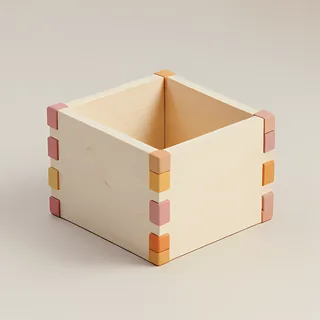
Woodworkers call this corner a box joint: complementary, interlocking profiles cut into two boards that then meet at a right angle, usually with glue. It has none of the mechanical lock of a dovetail, but it is much simpler to make and easy to mass-produce, which is how it moved from the tenon saw and chisel to the table saw and now to a beam of light. Laser users call the same thing a finger joint. Its strength comes from area, because the glued faces of all those fingers add up to far more surface than the thin edge of a plain corner.
That area matters because of grain. The Forest Products Laboratory’s Wood Handbook is blunt about it. A glued end-grain butt joint reaches only about 25 percent of the tensile strength of the wood along the grain, and where end grain meets edge grain the joint should be designed with interlocking surfaces, since more joint area gives more bondline to carry the load. Plywood softens the problem. Layers glued in crossing directions swell and shrink far less than a solid board does. Plywood does not remove it, though: the cut edge of a cross-bonded sheet still shows end grain in every other ply.
The geometry is a dispute over property. Two panels of thickness t that meet along an edge both lay claim to the same square strip of space, t by t, running the length of that edge, and three panels claim the same small cube at each corner. A finger joint is a rule that hands every part of the disputed material to exactly one owner, alternating along the edge so that each panel both gives and takes.
The count of fingers is odd for a reason. Split an edge into an even number and one end begins with a tab while the other begins with a slot, so the panel is no longer symmetric and it starts to matter which way round it goes. With an odd count both ends belong to the same panel. The generator on this page gives the front and back panels the corners and the first and last finger of every edge, and lets the sides outrank the top and bottom. It never draws fewer than three fingers, since with one the lesser panel would own nothing.
The width of a line
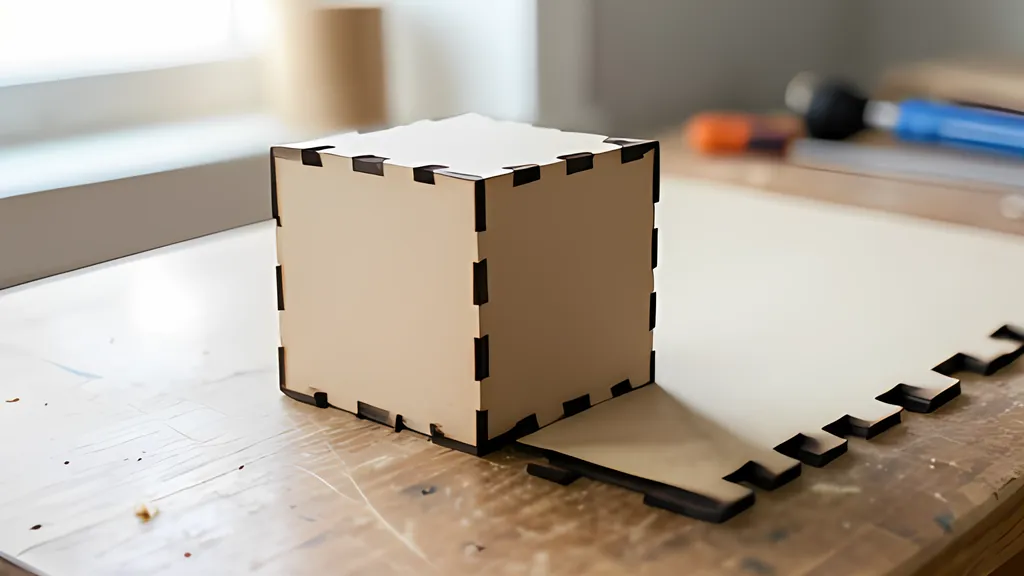
One laser program’s documentation defines kerf as the gap of material removed by the beam. Run that beam down the center of a drawn path and it takes material from both sides, so parts come out undersized and slots oversized.
The cure is an offset of half the kerf, and the sources agree on it. One cutting service tells customers that a 40 mm square cut with a 0.2 mm kerf should be submitted at 40.2 mm, and a 40 mm hole at 39.8 mm. The arithmetic is the same in inches: for a half-inch shaft and a kerf of a hundredth of an inch, the hole is drawn at 0.49 inch. Boxes.py, an open-source box generator, calls the quantity burn and defines it as half the width of the laser cut. For a box the result is tidy. Move every outline outward by half the kerf and each tab grows by one kerf while each slot shrinks by one.
Take the box the generator opens with: 100 x 70 x 50 mm outside, 3 mm plywood, fingers aimed at 9 mm. The long edge less two thicknesses is 94 mm, and the odd number nearest to 94 over 9 is 11, so each finger is 8.55 mm wide. The other edges get 7 fingers of 9.14 mm and 5 of 8.80 mm: 11, 7 and 5. At a kerf of 0.2 mm the file shows tabs 8.75 mm wide beside slots of 8.35 mm, a 0.4 mm mismatch that the beam removes. Inside, the box is 94 x 64 x 44 mm, about 265 cubic centimeters, and its six panels cover 284 square centimeters.
But which kerf? One service says its kerf starts at about 0.2 mm. A review of CO2 laser cutting of plastics puts the kerf of melt-cut polymers between 0.2 and 0.8 mm, depending on thickness. Students at a university fab lab measured 0.085 mm in 1 mm cardboard and 0.051 mm in 2 mm MDF. A 2025 study that cut 6 mm beech, oak, spruce, plywood and fiberboard on a CO2 laser with a maximum power of 135 watts, tuning each material toward a kerf of 0.30 mm, ended with averages from 0.29 to 0.35 mm. Call it 0.05 to 0.8 mm, a sixteenfold spread, across machines and materials that are all perfectly ordinary.
The reasons are physical, and none of them holds still. Thicker or harder material takes longer to cut and gets a wider kerf, the cutting service explains, curves are cut more slowly than straight lines and come out wider, and wood that is not flat drifts out of focus. The beam is cone shaped, so edges are not perfectly square. A study of spruce repeats the common finding that more power widens the kerf and more speed narrows it, and solid wood, with its grain, cuts less evenly than plywood or fiberboard. An earlier study of 3, 6 and 9 mm plywood treated the kerf at the top of the cut and at the bottom as two separate quantities.
So the kerf box in a generator is not a setting to be looked up. It is a measurement of one machine, one sheet and one set of speeds, and it has to be taken before it can be typed.
Tight enough to hold, loose enough to assemble
A press fit, as one research group puts it, holds parts by forcing them into slightly smaller openings. The Fab Academy course builds an assignment on it. Students characterize their laser’s kerf and joint clearance, then build a kit whose pieces stay together without adhesives and do not fall apart when lifted. The margin is thin. The Boxes.py manual says that for plywood even a hundredth of a millimeter makes a notable difference in how stiff the fit is, and it suggests adjusting in steps of 0.01 mm or even 0.005 mm. It also admits the counterintuitive part: a larger correction makes a tighter joint.
That thin margin is why a file that snaps together in one workshop rattles or cracks in another. The same researchers, at the Hasso Plattner Institute, describe press fits as susceptible to the small changes that come with a machine that removes more or less material, and to changes in stiffness when the material changes. On a machine with a smaller kerf the part cannot be inserted completely. On one with a wider kerf it is loose and falls out. Cut from brittle material, it breaks. A box file is never simply finished. It is finished for one machine.
Glue asks for the opposite. Boxes.py puts it in two sentences: spongy materials like wood can be cut oversized and pressed together, while brittle ones like acrylic need to be cut undersized to leave a gap for the glue. The Wood Handbook reports that with stiff structural adhesives the strongest bonds have gluelines between 0.08 and 0.15 mm thick, and that thicker ones grow weaker. So the generator keeps two ideas apart. Kerf says what the machine removes. Clearance says what fit is wanted, as a gap on each side of every finger, negative for a press.
The sheet is not the label
Finger depth is sheet thickness, and the sheet rarely matches its label. The United States product standard for structural plywood lets a sanded panel in its quarter-inch category measure anything from 5.95 to 6.75 mm, and one in the three-eighths category 9.13 to 9.92 mm. That 0.8 mm band is four times the kerf in the example above. The same standard ties its measurements to a moisture content of 9 percent, a reminder that a panel changes with the weather. Boxes.py is emphatic: always measure the thickness of every sheet. Enter a value too large and the tabs stand proud of the corner. Enter one too small and they sit below it.
All of which argues for a test coupon before the box. Boxes.py describes the simplest: cut a rectangle, measure how much smaller it came out than drawn, and take about half the difference. The fab lab students cut a strip into 20 pieces, pushed them together, found 1.78 mm missing, and divided by 21 cuts to get 0.085 mm. Then they cut a comb of ten slits, from 3 mm down in steps of 0.05 mm, and found that a 3 mm test piece fitted best at 2.7 mm. They added that this does not necessarily match the measured kerf, because stiffness and density change the fit. That remark is the lesson. Test the fit.
Scorch is the other thing a coupon shows. One laser maker’s support pages concede that a certain amount of burning is unavoidable when a CO2 laser cuts wood. They suggest air assist to blow smoke and debris away, transfer tape to protect the face, and sandpaper afterward. Boxes.py even has a setting for extra finger length to grind away burn marks. Sand the faces, not the flanks, because the flanks are the fit that was just measured.
A router has a different trouble. A spinning cutter is round, so the smallest inside corner it can make has the radius of the cutter, and a square tab will not seat in a rounded slot. The usual fix is the dog-bone, which extends the corner in two directions. One machining guide centers the relief the square root of R squared over two from the corner, so that no more is removed than necessary. Given a bit diameter, the generator draws that as a half circle at every inside corner. With a 3.175 mm bit each one reaches about 0.46 mm past the wall.
What the method cannot do makes a longer list than what it can. It draws boxes with flat walls that meet at right angles, and nothing else: no living hinges, no angled walls, no sliding lids, no dividers. It treats every cut as perfectly vertical, although the beam is a cone and the top and bottom of a kerf differ. It assumes one thickness across a flat sheet. It says nothing about strength. And it does not know the machine. The kerf it compensates is whatever number was typed.
The drawing is exact and the burn is not. A finger-jointed box works when the two are reconciled on a scrap of the same sheet before the real cut. Measure the sheet. Cut the coupon. Then cut the box.
Sources
Every source consulted for this guide. Links checked October 3, 2026.
- Laser cutting | TRUMPF TRUMPF
- ENERGY DOSE AND SPECIFIC CUTTING ENERGY IN CO₂ LASER CUTTING OF SOLID AND ENGINEERED WOOD MATERIALS Acta Facultatis Xylologiae Zvolen, vol. 67, no. 2 (2025), Technical University in Zvolen, CC BY 4.0
- ANN Prediction of Laser Power, Cutting Speed, and Number of Cut Annual Rings and Their Influence on Selected Cutting Characteristics of Spruce Wood for CO2 Laser Processing Materials, vol. 17, no. 13 (2024), on PubMed Central, CC BY 4.0
- State-Of-The-Art and Trends in CO2 Laser Cutting of Polymeric Materials-A Review Materials, vol. 13, no. 17 (2020), on PubMed Central, CC BY 4.0
- Evalaution and optimization of laser cutting parametersfor plywood materials University of the West of Scotland research portal (Optics and Lasers in Engineering, vol. 51, 2013)
- Box joint - Wikipedia Wikipedia
- Chapter 10: Wood adhesives: bond formation and performance USDA Forest Service, Forest Products Laboratory (Wood Handbook, FPL-GTR-282, 2021)
- Kerf - What it is and How to Compensate LightBurn Software documentation
- How much material does the laser burn away? | Ponoko Help Center Ponoko
- Using Boxes.py - boxes.py documentation Florian Festi, Boxes.py
- Edges - boxes.py documentation Florian Festi, Boxes.py
- Fab Lab Aachen @ Fab Academy Fab Lab Aachen, RWTH Aachen University
- Computer-Controlled Cutting Fab Academy, assessment guide
- springFit: Joints and Mounts that Fabricate on Any Laser-Cutter Hasso Plattner Institute (UIST 2019)
- Structural Plywood, Voluntary Product Standard PS 1-09 National Institute of Standards and Technology, U.S. Department of Commerce
- Avoiding Wood Char/Burning Full Spectrum Laser
- How to Machine Square Corners with CNC Milling Get It Made