The guide
A storage system is a promise about 42 millimeters, and Gridfinity keeps it
Bins drawn by strangers drop into the same baseplate because the system is a handful of published numbers, not a product.
- 42 mm grid pitch, the same in both directions
- 7 mm one unit of height
- 0.25 mm gap left on each side of a bin in its cell
- 4.4 mm what a stacking lip adds on top
- 6 x 2 mm magnet the corner pockets are meant for
Read the full guide Fold the guide
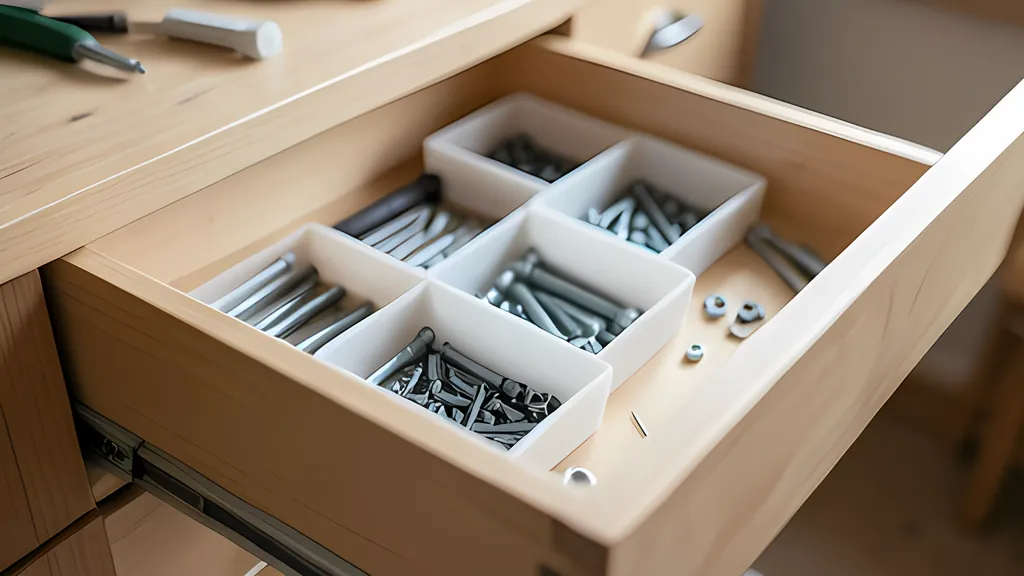
Every workshop drawer starts as a plan and ends as a pile. The tray that came with the screws does not match the tray that came with the drill bits, and nothing bought last year sits square beside anything bought this year. A storage system fixes that only when every part, from every maker, agrees on one thing: where its edges are.
Gridfinity is that agreement, written down. Zack Freedman designed it in 2022, and the community site that grew up around it records that the designs were first released in a video called “Gridfinity: Your Ultimate Modular Workshop is FREE!”. The same site calls the system free, open source and almost entirely 3D printable, and it states the rule as a joke. The best things in life, it says, are integer multiples of 42x42x7mm.
A grid is a promise
The numbers are few. Bins and baseplates repeat on a pitch of 42 mm in both directions, and height is counted in units of 7 mm. Freedman’s own download page spells out the naming: width, then depth, then height, the first two in 42 mm grid slots and the last in 7 mm units. So a bin labeled 2x1x3 covers two cells by one, and its body is 21 mm tall. Why 42? The documentation of an OpenSCAD rebuild of the bins glosses its default as the Answer to the Ultimate Question of Life, the Universe, and Everything. The joke is the point. Any number would have worked, provided everyone used the same one.
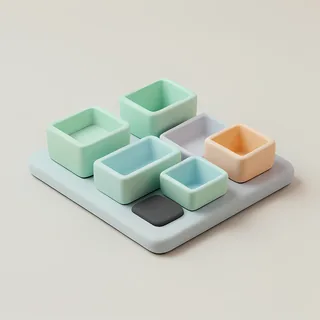
The baseplate is the grid made solid, a frame of 42 mm cells. Freedman’s pages state the consequence without hedging: all storage blocks are compatible with all baseplates.
That sentence is the whole system. A bin does not need to know what sits beside it, who drew it, or what it holds. It needs the right foot.
Who may use those numbers is settled as well. The community site says the design was partly inspired by Alexandre Chappel’s Assortment System and was released as a framework for others to extend, under the MIT license. Freedman’s download pages each carry an MIT license file, and the OpenSCAD rebuild reproduces that license with a 2023 copyright line naming Zachary Freedman and Voidstar Lab LLC. It was not always so. A 2023 report in the site’s issue tracker, headed “No longer non-commercial”, notes that the designs had been re-licensed as MIT while an older notice was still on show. Read the license attached to the file you actually download.
The foot does the locating
The rebuild’s source writes the foot of a bin as three moves, bottom to top: out 0.8 mm at 45 degrees, straight up 1.8 mm, out 2.15 mm at 45 degrees. That is 4.75 mm of height, and it widens the foot from 35.6 mm at the bottom to 41.5 mm at the top. The baseplate cell is the same shape turned into a socket, 0.7, 1.8 and 2.15 mm, cut into a 42 mm square. The top of the foot is half a millimeter narrower than the pitch. Split in two, that is 0.25 mm of air on each side of every bin, so neighbors in a full drawer never press on each other.
A quarter millimeter is not an accident. The University of Florida’s makerspace lists 0.20 to 0.25 mm as the standard sliding clearance for printed tabs, rails and enclosures, tighter than a loose cover and looser than a locating feature. The same page praises the tapered lead-in, an edge that narrows so that parts guide themselves into alignment. A Gridfinity foot is almost nothing but lead-in.
The stacking lip is the socket again, moved to the rim of the bin: 0.7, 1.8 and 1.9 mm. It adds 4.4 mm, which is why the rebuild lists a stock two-unit bin with a lip as 18.4 mm tall.
Above the foot, the published numbers thin out. Freedman’s pages give a grid pitch, a height unit and a magnet size. They give no wall thickness, no floor height and no divider width, so anyone who rebuilds the bins has to choose those. That silence is freedom, and people have used it. The encyclopedia entry speaks of a plethora of components, and of generators that make them to order.
Why nothing needs support
Freedman’s bins come with a plain claim: brims and support are not required, in any filament, with a nozzle of 0.6 mm or smaller. The geometry earns it. The Slic3r manual says most models print with overhangs up to an angle set mainly by layer height and line width, usually around 45 degrees. At that slope, with a layer half as tall as the line is wide, each new line still rests on half of the one beneath. Every sloped face of the foot and the lip sits exactly there.
The same guide asks for a 45 degree chamfer or a radius on every edge that touches the build plate. The reason is the first layer. Pressed down hard so that it sticks, it flares into what the guide calls an elephant’s foot, plastic that protrudes beyond the drawn size and gets in the way of assembly. The small chamfer at the bottom of a Gridfinity foot leaves that flare some room before it can reach the socket.
Two features lean on the rule. The roof of a magnet pocket is a flat span 6.5 mm across, a little past the 5 mm that Cura, by default, takes as the shortest unsupported wall worth treating as a bridge. It faces the baseplate, so nobody sees it. The label tab is the other. In the rebuild its underside rises only 36 degrees from horizontal, and the source file marks the tab values as arbitrarily chosen.
The tab has a history of compromise. Freedman’s page says it fits 12 mm label tape, and that two-unit bins have no label at all because one would cut too far into the storage space. The community’s answer page is blunter: 12 mm tape fits but is tight, and 9 mm is ideal.
Walls are thin on purpose, and no two authors agree on how thin. The rebuild sets a minimum of 0.95 mm, with 1.2 mm dividers and a 2.8 mm radius inside each corner. A second open implementation, a Python library built on CadQuery and also under the MIT license, lists a nominal outer wall of 1.0 mm, the same 1.2 mm dividers and a 1.1 mm inside radius. Both put the compartment floor 7 mm up, one full height unit, and both give the foot 4.75 mm. Everything above that, each author simply decided.
Flat parts fight back. Freedman warns that wider bins can curl and that baseplates love to, their large contact area making them hard to release. He puts the limit of one common printer at a five by five grid.
Magnets, plastic and heat
Magnets are optional. Freedman’s pages say 6 x 2 mm magnets can go in the corners, or M3 screws, and that the magnets will not magnetize the contents. The rebuild cuts four pockets under every unit. Each is 6.5 mm wide, with its center 4.8 mm in from the edge of the foot, which is 8 mm from the edge of the cell, and by default 2.4 mm deep: the magnet plus two printed layers. The minimal frame baseplate has no room for magnets or screws, Freedman notes, but on a steel surface magnets in the bins alone will hold. The community’s answer page says glue them in and keep the poles consistent.
Heat reaches the plastic first. K&J Magnetics works through one N42 disc and finds 80 C to be its maximum operating temperature, beyond which it starts to lose strength for good. One maker’s data sheet for PLA puts the heat distortion temperature at 55 C and the glass transition at 60 C. A bin left somewhere hot would soften well before its magnets weakened.
One bin, worked through
Take a bin two cells wide, one deep and three units high, with a lip, a scoop, a 13 mm label tab and magnet pockets. Its outside is 2 times 42 less 0.5, or 83.5 mm, by 41.5 mm, by 3 times 7 plus 4.4, or 25.4 mm. Give it 0.95 mm walls and one divider. Each compartment is then 40.2 mm wide and 39.6 mm long. With the floor at 7 mm, where the rebuild puts it, and the dividers stopping 1.2 mm short of the body top, each is 12.8 mm deep.
A generator given those values reports 35.3 cubic centimeters of plastic. At 1.24 grams per cubic centimeter, the figure on one PLA data sheet, that is about 44 g printed solid, and a slicer with infill uses less. The matching baseplate is 84 by 42 by 5 mm.
What leaves the generator is an STL file. The Library of Congress describes the format as an openly documented way to describe a surface as triangular facets, first documented by 3D Systems in 1988. Each triangle is three corners and a normal pointing outward. Nothing in the file knows about feet or grids.
What a generator of this kind cannot do is leave its family. It makes plain bins and a plain frame baseplate. It does not make the weighted baseplate Freedman describes, with its screws, magnets and metal weights. It makes no lids, tool holders or shaped cutouts. Nor is there one reference to be exact against: the rebuild’s author admits that some of his geometry, mainly fillets, differs slightly from the original. Two bins can both be compatible and still disagree about everything above the foot.
The grid has a cost as well. The encyclopedia entry cites a 2026 review that liked the system in drawers but found the baseplate restrictive and hungry for material elsewhere, and its fixed dimensions wasteful for odd-sized objects. A 42 mm cell taxes everything 45 mm wide.
So print one cell of baseplate and one small bin before a drawer’s worth. If the bin drops in and lifts out with a slight rattle, the promise holds on your printer. The rest is counting.
Sources
Every source consulted for this guide. Links checked October 6, 2026.
- Gridfinity :: Unofficial wiki | Gridfinity gridfinity.xyz, community site
- Gridfinity | The modular, open-source grid storage system. gridfinity.xyz, FAQs page
- Gridfinity Divider Bins - 3D model by ZackFreedman on Thangs Zack Freedman on Thangs, Internet Archive copy of 5 July 2026
- Gridfinity Baseplates - 3D model by ZackFreedman on Thangs Zack Freedman on Thangs, Internet Archive copy of 15 July 2026
- No longer non-commercial - Issue #26 - gridfinity-unofficial/gridfinity-unofficial.github.io GitHub, issue tracker of the community site
- GitHub - kennetek/gridfinity-rebuilt-openscad: A ground-up rebuild of the stock gridfinity bins in OpenSCAD Kenneth Hodson and contributors, GitHub
- gridfinity-rebuilt-openscad/src/core/standard.scad at main Kenneth Hodson and contributors, GitHub
- gridfinity-rebuilt-openscad/src/core/gridfinity-baseplate.scad at main Kenneth Hodson and contributors, GitHub
- gridfinity-rebuilt-openscad/gridfinity-rebuilt-bins.scad at main Kenneth Hodson and contributors, GitHub
- gridfinity-rebuilt-openscad/LICENSE at main Kenneth Hodson and contributors, GitHub
- Bins - Gridfinity Rebuilt gridfinity-rebuilt-openscad documentation
- GitHub - michaelgale/cq-gridfinity: A python library to build parameterized gridfinity compatible objects such a baseplates and boxes. Michael Gale, GitHub
- cq-gridfinity/cqgridfinity/constants.py at main Michael Gale, GitHub
- Gridfinity - Wikipedia Wikipedia
- Slic3r Manual - Support Material Slic3r project, CC BY-SA 3.0
- Cura/resources/definitions/fdmprinter.def.json at main - Ultimaker/Cura UltiMaker, on GitHub (LGPL-3.0)
- Designing for 3D Printing Tolerances on the MK4 and XL Marston Makerspace, University of Florida Libraries
- Technical Data Sheet: The Filament PLA Spectrum Filaments
- Temperature and Neodymium Magnets | K&J Magnetics Blog K&J Magnetics
- STL (STereoLithography) File Format Family Library of Congress, Sustainability of Digital Formats