The guide
A mirror anamorphosis is one law of optics, applied to every point of a picture
The smear around a mirror cylinder is not a trick of style. It is what the law of reflection demands when a picture has to be seen from one place and drawn in another.
- 1638 Niceron publishes his guide to anamorphic painting
- 1533 Holbein hides a stretched skull in The Ambassadors
- 80.4 mm where the middle of the worked example lands, from the circle's center
- 50.2 mm how wide a 50 mm cylinder looks from 300 mm away
- 210 x 297 mm A4, one of the sheets the smear has to fit
Read the full guide Fold the guide
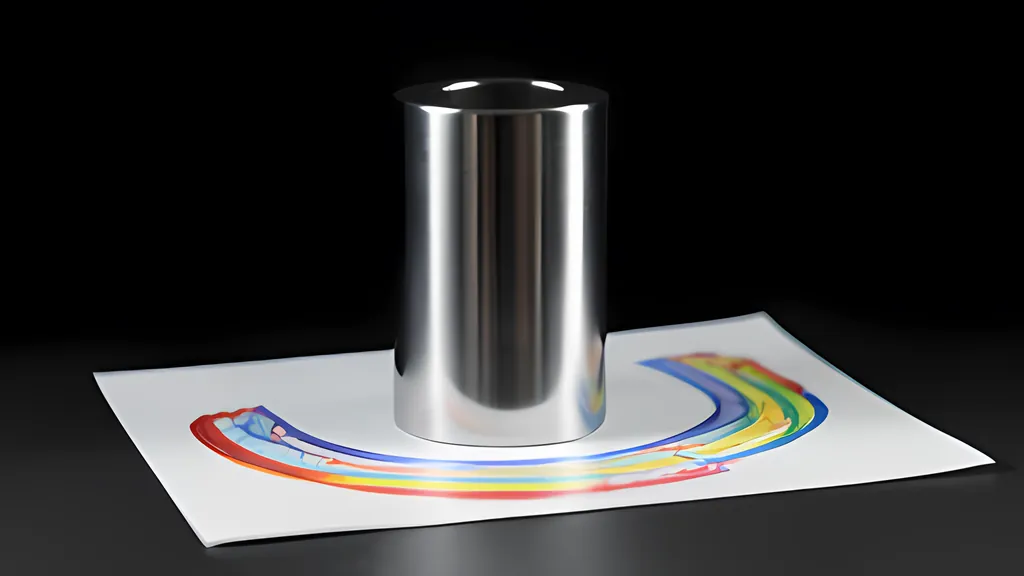
A sheet of paper lies on a table with a wide, curved smear of color on it. Nothing in the smear looks like anything. Stand a mirror cylinder on the marked circle, look into it from the right spot, and a small, upright, perfectly proportioned picture is standing inside the glass.
It feels like a secret being unlocked. It is closer to arithmetic. Every point of that smear was put where one rule of optics said it had to go, and the rule is short enough to say in a breath.
A picture that needs the right place to stand
An anamorphosis is a deformed image that shows its true shape only when it is looked at in some unconventional way. The Museo Galileo describes it as a coding and decoding process: a figure is drawn pre-distorted until it is unrecognizable, and then a particular angle of view, or a special mirror, cancels the distortion.
There are two main families. In the oblique kind, the viewer has to stand far off to one side. The best known example hangs in the National Gallery in London: the long pale shape between the feet of the two men in Holbein’s painting of 1533, The Ambassadors, resolves into a skull only when the canvas is seen side on, from an acute angle. The other family uses a mirror, usually a cylinder, a cone or a pyramid, and is called catoptric. Three things are needed to set one up: a mirror, an observer, and the surface on which the distorted image lies. Change any one of the three and the image has to be drawn again.
The mirror kind has a long paper trail. Early perspective anamorphoses date to the Renaissance, and a drawing of an eye by Leonardo, kept in the Codex Atlanticus, is counted as the earliest known. Mirror anamorphosis was being made on a large scale in China during the late Ming dynasty, mostly freehand, and the first European manual on it appeared around 1630. In 1638 a Minim friar named Niceron, then 25, published in Paris a folio treatise on the whole art, having worked out the geometry for producing such pictures. Its third book explains figures seen by reflection in flat, cylindrical and conical mirrors. He died in 1646, at 33.
A century later the cylinder had become a parlor instrument. The Science Museum in London holds an oil painting from about 1744 to 1774 that resolves into the stern of a warship in a cylindrical mirror, and a cylindrical mirror of glass and wood that came with it, measuring 230 mm by 50 mm by 50 mm. It also holds an anamorphic portrait of King Charles I, dated between 1740 and 1790. The museum’s notes say such paintings were fashionable in the mid eighteenth century and were displayed in cabinets and stately homes.
One law does all the work
A mirror reflects each ray in one direction only, and the direction is fixed by the law of reflection: the angle of reflection equals the angle of incidence, both measured from the line that stands square to the surface where the ray strikes, with the two rays and that line all in one plane. That is the entire physics of the device.
In vector form the law is one line. If a ray travels in direction d and meets a surface whose unit normal is n, it leaves in direction d minus twice the part of d that lies along n. The part of the motion along the surface is kept, and the part into the surface is turned around.
Now the construction. Imagine the finished picture on a small screen floating inside the cylinder, facing the eye. Take one point of it. The eye sees that point along a straight line, and that line strikes the mirror somewhere on its front. Reflect the line there and follow it down until it meets the paper. That spot on the paper must carry the color of the picture point.
Do this for every point and the smear is finished. One researcher who built a general procedure for mirror anamorphoses describes it in these terms, and notes how old the idea is: an eighteenth century encyclopedia suggested drilling holes in the design, holding a candle where the eye should be, and marking where each spot of light fell.
The reverse question is harder than it sounds. Given a spot on the paper, which point of a round mirror sends it to the eye? That is the circle mirror problem named after Alhazen, who solved it in general in the eleventh century; Ptolemy had treated special cases in the second. It cannot be solved with compass and straightedge, a fact that was only proved in 1965, when the answer was written as a root of an equation of the fourth degree. A computer finds it by trying angles until the two sides of the reflection match.
How a curve squeezes a smear into a picture
A convex mirror bulges toward the viewer. It reflects light outward, spreading rays apart where a hollow mirror would gather them, and what it shows is smaller than the thing itself. Run that backward and a wide sweep of paper is gathered into a narrow bundle of sight lines. The lengths of the drawing’s curves are reduced when seen in the curved mirror, which is why the distortions resolve into a picture. A cylinder is curved in one direction only. Around its girth it is a convex mirror, and along its height the surface is straight, so there it reflects as a flat one does. That is why the smear is stretched so much more sideways than it is lengthways.
Here is a worked example that can be reproduced. The cylinder is 50 mm across and 110 mm tall. The eye is 300 mm from the cylinder’s center and 250 mm above the table. From there the cylinder looks 50.2 mm wide, slightly more than it measures, because the lines of sight that graze its sides are not parallel.
Put a square picture 36 mm on a side in the mirror with its middle 23 mm above the table. The ray to the middle of the picture meets the glass 41.9 mm up, turns around, and lands 80.4 mm from the center of the circle, straight toward the viewer. The top of the picture’s middle column lands at 115.5 mm and the bottom at 49.5 mm, so 36 mm of picture is drawn over 66 mm of paper.
Sideways the stretch is far greater. The whole smear is 201 mm wide for a picture 36 mm wide. The top of the picture is drawn farthest from the cylinder and the bottom nearest, so the sheet reads upside down to the person looking at it, and no flipping by hand is needed to make the mirror show it the right way round.
Tracing also corrects a tidy story that is often told, in which upright lines of the picture become straight spokes and level lines become circles around the cylinder. In this example the level line through the middle of the picture is 80.4 mm from the center of the circle at its midpoint and 68.7 mm at its ends. It is an arc, but not a circle about the cylinder, and only the middle upright line is a true spoke.
Drawing it by hand, and choosing the parts
Nobody has to move every point. The classic method lays a grid of control points over the design and works out only where the grid goes, then copies the picture square by square into the bent cells. Two neighboring points of the original can end up far apart on the paper, so the cells near the outside of the smear are large and the ones near the cylinder are small. A printed grid with matching cell names in the mirror and on the paper is all the help a careful hand needs. Draw what is in square B3 of the picture inside the bent cell marked B3, and keep going.
The mirror will forgive a shaky line. It will not forgive a line in the wrong cell, and it will not forgive a sheet printed at the wrong size.
The cylinder sets the scale. The picture can be no wider than the cylinder appears, so a 50 mm mirror holds a picture a little under 50 mm wide, and the smear around it will be several times that. With the example above it fits on one sheet of A4, which is 210 x 297 mm, or on US Letter at 216 x 279 mm. A wider cylinder or a lower eye soon needs A3 at 297 x 420 mm, or several sheets taped edge to edge.
Print at full size and measure. A sheet printed at 97 percent has a circle that no longer matches the cylinder, and every ray then lands slightly off. Use pictures you have the right to use.
What it cannot do
It works for one eye point. The sheet is computed for a single place in space, and from anywhere else the same reflections assemble a different, bent picture. A mirror anamorphosis is more forgiving than the oblique kind, and people standing around the table will all recognize the image. Only one of them sees it true.
It leaves blank zones. Some rays from the eye miss the mirror, pass over its top, or reflect level and never come down, and those parts of the picture cannot be drawn anywhere. The paper under the cylinder is hidden, and the paper straight behind it sends nothing to the eye.
It is only as good as the mirror. The law of reflection is applied at each point of the surface, so a dent or a ripple tilts the normal there and sends that ray to the wrong part of the paper. A cylinder that is not truly round still shows the picture, but with a wobble wherever its surface leaves the circle.
And it is flat. The picture in the mirror has no depth of its own, and a camera at the eye point records it exactly as one eye does. That is the honest limit of the method and also its charm: a smear, a cylinder, and one rule, agreeing at a single point in the air.
Sources
Every source consulted for this guide. Links checked October 5, 2026.
- A General Procedure for the Construction of Mirror Anamorphoses The Bridges Archive, Proceedings of Bridges 2010
- A New Kind of Three-Dimensional Anamorphosis The Bridges Archive, Proceedings of Bridges 2011
- Specular reflection - Wikipedia Wikipedia
- Curved mirror - Wikipedia Wikipedia
- Alhazen's problem - Wikipedia Wikipedia
- Jean François Niceron - Wikipedia Wikipedia
- The Ambassadors (Holbein) - Wikipedia Wikipedia
- Anamorphosis Painting of Perspective View of a Ship Model Science Museum Group Collection
- Cylindrical mirror Science Museum Group Collection
- Anamorphosis of King Charles I Science Museum Group Collection
- Museo Galileo - In depth - Anamorphosis Museo Galileo, Institute and Museum of the History of Science
- What is anamorphosis? Phillip Kent, Art of Anamorphosis
- International standard paper sizes Markus Kuhn, University of Cambridge Computer Laboratory
- Anamorphosis Wikipedia