
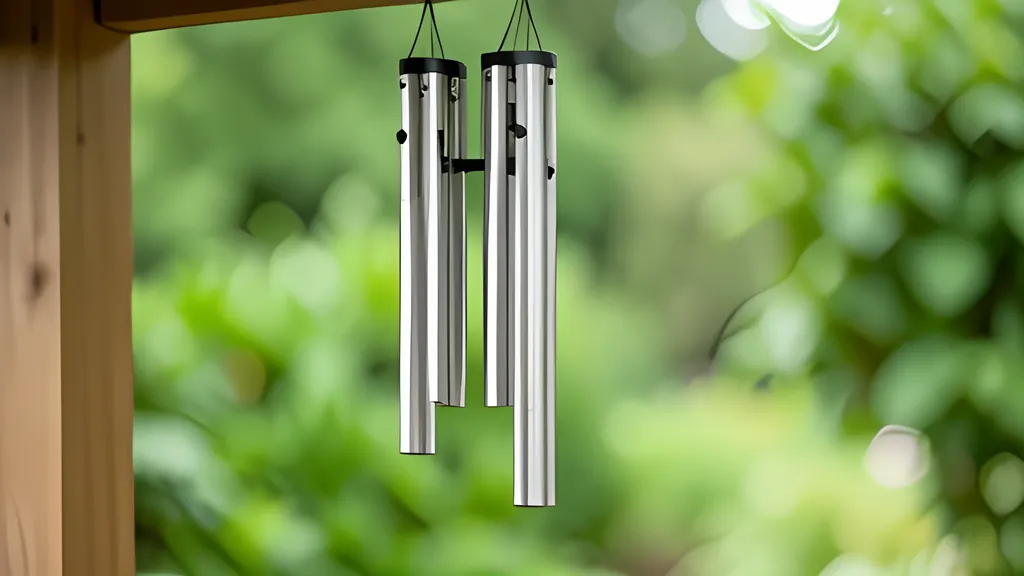
The guide
A wind chime tube is a bending bar, not an organ pipe, and that changes every number
The metal sets the note, not the air inside it. That one fact explains why length goes with the square root, why the hang hole has a right place, and why a formula only gets you close.
- 22.42% of the length from each end: where the first mode stands still
- 2.76 and 5.40 a free bar's overtones, as multiples of its fundamental
- 0.7071 length factor for the same tube one octave higher
- 538.0 mm formula length of a 25.4 x 1.6 mm aluminium tube at C5
- about 1% how close a calculated length lands, by one builder's account
Read the full guide Fold the guide
A wind chime looks like a row of small organ pipes, and most people who set out to build one start from that picture. It is the wrong picture. An organ pipe is a container for a column of air, and the air does the singing. A chime tube is a piece of metal that has been hit, and the metal does the singing. Almost every surprise in chime making follows from mixing the two up.
The metal rings, not the air
In an organ pipe the pitch comes from the resonance of the air column, and the pipe’s material only colors the sound. In a chime the vibration of the tube itself radiates the sound after the strike, so the air inside has little to do with the pitch.
What the metal does is bend. Struck on its side, a tube flexes like a very stiff ruler, bowing one way and then the other hundreds of times a second. Engineers call this a beam that is free at both ends, and a chime tube can be modelled as exactly that. The hollow only changes the shape of the cross section.
The frequency of the lowest bending mode is a constant, 22.3733, divided by two pi and by the square of the length, times the square root of stiffness over mass per unit length. Stiffness here is Young’s modulus times the second moment of area of the cross section. For a round tube that moment is pi times the difference of the fourth powers of the outer and inner diameters, over 64. That looks heavy, but it collapses. Divide the moment by the area, take the square root, and what is left is the square root of the sum of the two squared diameters, divided by four. The material adds the square root of modulus over density.
Why the length goes with the square root
Length appears squared, and that is the first thing a builder has to unlearn. On a string or in a pipe, half the length gives an octave. On a bending bar, half the length gives two octaves, because frequency goes with one over the length squared. Turn it around and length goes with one over the square root of frequency.
So a tube that sounds an octave higher is not half as long. It is 0.7071 times as long, one over the square root of two. A full octave of chimes spans a much smaller range of lengths than a rank of pipes would, which is why a five-note set looks like a gentle staircase and not a steep one.
Here is a set you can reproduce. Take aluminium tube 25.4 mm across with a 1.6 mm wall, and typical figures of 69 GPa for the modulus and 2,712 kilograms per cubic meter for the density. With A4 at 440 Hz, the C above it is 523.25 Hz in equal temperament. The formula asks for a tube 538.0 mm long. The A at the top of a major pentatonic set, 880 Hz, wants 414.9 mm.
The still point and the stubborn overtones
A bar bending in its lowest mode does not move everywhere. The middle swings one way while the two ends swing the other, and between them are two points that stay put. Those nodes sit at 22.42% of the length from each end. On the 538.0 mm tube that is 120.6 mm.
Hang the tube there and the cord has nothing to fight. A tube supported at a node vibrates as if the support did not exist, and it gives its clearest and loudest tone. Hang it anywhere else and the cord drags on moving metal and steals the ring. Vibraphone bars are strung at the same two points, so that they sustain. The node also does a second job. Higher modes have their still points in other places, so a support at the first mode’s node sits on moving metal for some of them. Some of the higher partials are damped and the fundamental rings the loudest. One hole, drilled in the right spot, is a small filter.
A string’s overtones are whole multiples of its fundamental: two, three, four times. A free bar’s are not. The next two bending modes come in at 2.76 and 5.40 times the fundamental, then 8.93. None of those is a musical interval above the first, and no amount of care in the cutting will make them one. They belong to the shape of the object.
What that does to the ear is less tidy than the arithmetic, and it is worth being careful. Chimes are among the percussion instruments that one encyclopedia entry on inharmonicity lists as making complex and inharmonic sounds. For orchestral tubular bells the consequence is on record: makers and listeners disagree by a whole octave about which note a tube plays, and the reason given is the instrument’s complex overtones.
Length changes the balance. One experienced builder reports that on long, low tubes the fundamental and first overtone are hard to hear at all, and the ear assembles a note from what remains, while short, high tubes sound mostly like a pure fundamental. The same builder warns that electronic tuners often cannot correctly identify a chime’s note, especially below about C5. Of orchestral tubular bells, the same entry says the fourth, fifth and sixth modes fall close enough to the ratios 2:3:4 for the ear to treat them as nearly harmonic, and that the pitch it names lies an octave below the fourth mode: the missing first member of that series.
That is why no honest calculator promises what you will hear. It can say where the first bending mode will sit. It cannot say which pitch a listener will name for a long tube.
Metal, wall, and one real tube
Only two properties of the metal enter the formula, its stiffness and its density, and they enter as a ratio. Aluminium is light and not very stiff. Steel is about three times as stiff and about three times as dense. The ratio comes out nearly the same, so an aluminium tube and a steel tube of the same size want lengths within a percent or so of each other on typical figures. Copper and brass, dense but only moderately stiff, need noticeably shorter tubes for the same note.
The words typical figures carry weight. One engineering reference gives aluminium 69 GPa, and Wikipedia’s table of approximate values gives 68. For brass the same reference gives a range from 102 to 125 GPa, a copper industry data sheet gives 110 GPa for a standard 70/30 brass, and the Wikipedia table says 106. Brass is a family of alloys, not one material, and tempers differ.
Wall thickness matters less than people expect. Because the cross section enters only through that sum of squared diameters, doubling the wall of the example tube to 3.2 mm shortens the C5 tube by about three percent. A solid rod of the same diameter is the extreme case, and it comes out near 84 percent of the length of a thin tube.
The theory behind all of this treats the bar as thin. It leaves out two effects, shear and the turning inertia of each slice of the bar, and so it predicts frequencies a little too high. For a bar twenty or more times as long as it is thick the error is minor, and it grows as the bar gets stubbier. The theory also knows nothing about the hole you drill, a cap on the end, or a decorative angle cut, which by one builder’s account can shift a short tube by as much as ten percent.
Then there is the stock itself. Tubing has a tolerance on its diameter and wall, and the alloy on the rack is rarely the alloy in a table. The builder whose published tables match this formula says calculated lengths land about 1% from the target note. In musical terms one percent of frequency is roughly 17 cents, about a sixth of a semitone.
So measure. Cut the longest tube first, to the formula length or a little over. Hang it at the node, strike it, and read its frequency. Suppose the 538.0 mm tube rings at 510 Hz and not at 523.25. The ratio is 0.9747, and because frequency goes with one over length squared, every length in the set should be multiplied by the square root of that, 0.9873. The C tube becomes 531.2 mm.
That single measurement absorbs the alloy, the wall and the holes in one number. It is worth more than a better formula.
Notes that survive being shuffled
The wind does not play melodies. It strikes tubes in no order, often two at once, so the set has to sound agreeable in any combination. That is the case for the pentatonic collection, five notes built with the step pattern 2, 2, 3, 2, 3 in semitones. It leaves out the two notes of the major scale that create half steps, so no pair of tubes forms the tightest clash, and no single note insists on being home.
Most chimes use pentatonic or four-note scales for that reason: fewer dissonant intervals when notes are struck at random. A whole-tone set, all whole steps, is another collection with no half step in it. One builder prefers the notes of a ninth chord, C, E, G, B flat and D, and finds the pentatonic pleasant up close but inclined to blur at a distance.
Where the striker lands is less settled. One source says a strike at the center of the tube gives the loudest fundamental. Another says the end of the tube is the ideal strike point and warns against dead center, which is a node of the second mode. Both agree that it changes the mix of overtones, so it is a thing to try by hand before fixing the striker’s height.
A chime is a small lesson in what calculation is for. The physics gives the shape of the answer exactly: the square root, the node, the stubborn overtones. The numbers that fill in that shape come from a particular piece of metal, and the only way to learn them is to cut one tube and listen.
Sources
Every source consulted for this guide. Links checked October 6, 2026.
- Wind chime Wikipedia
- Euler-Bernoulli beam theory Wikipedia
- Chime Design and Build - Say It With Chimes Lee Hite
- Tubular Bell Chimes Design Handbook Leland L. Hite
- Pre-Calculated Tubular Wind Chime Dimensions Lee Hite
- Young's Modulus of Elasticity - Values for Common Materials The Engineering ToolBox
- Metals and Alloys - Densities The Engineering ToolBox
- Copper.org - C26000 Alloy Copper Development Association
- MIDI tuning standard Wikipedia
- Collections Open Music Theory
- Tubular bells Wikipedia
- Inharmonicity Wikipedia
- Vibraphone Wikipedia
- Young's modulus Wikipedia