
The guide
Sand on a singing plate drew the patterns that mathematics took decades to explain
Ernst Chladni bowed metal plates and let sand show where they stood still. The figures won him an audience with Napoleon, set Sophie Germain a ten-year problem, and still resist a simple formula.
- 1787 the year Chladni published his sand figures
- 8 January 1816 Sophie Germain wins the Paris Academy prize for plate theory
- 57.0 Hz lowest mode of a free 240 mm steel plate 1 mm thick, by theory
- 83.0 Hz the same mode by the simple cosine estimate
- 85 dBA long or repeated exposure from here up can harm hearing
Read the full guide Fold the guide
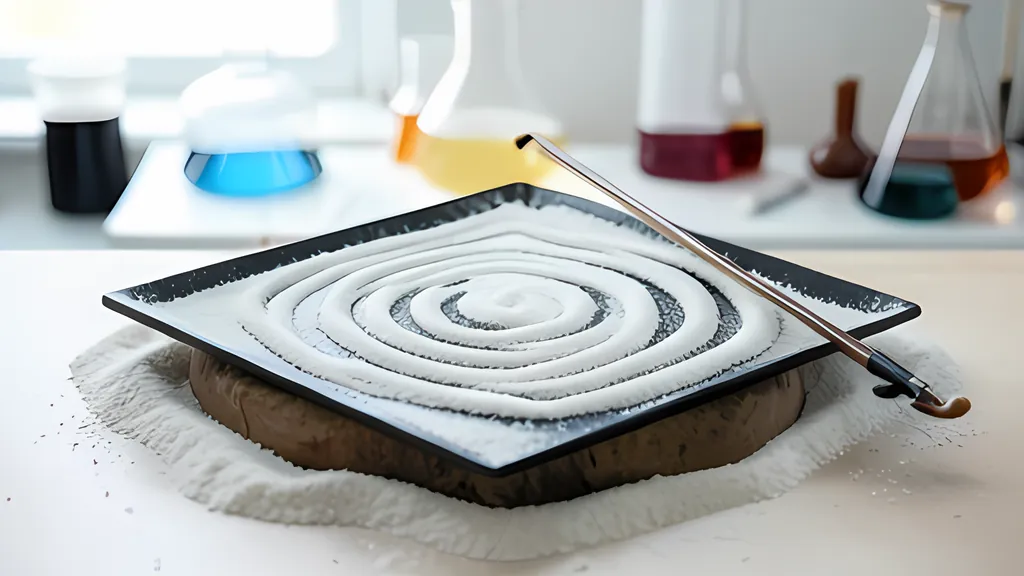
Scatter sand on a metal plate, draw a violin bow down its edge, and the sand begins to dance. Within seconds it has left most of the plate bare and gathered into thin, sharp lines: a cross, a ring, a lattice of curves. Change the note and the lines rearrange themselves. Nobody painted the pattern. The plate drew it.
Ernst Chladni made this his life’s work. He was born in Wittenberg in 1756, took a law degree at Leipzig in 1782 because his father insisted, and turned to physics the year his father died. In 1787 he published the method in a book whose title translates as Discoveries in the Theory of Sound. The idea was not wholly new. Robert Hooke had bowed a glass plate dusted with flour in 1680 and seen nodal patterns, and nothing came of it. Chladni did it systematically, with metal and sand, and toured Europe showing the results.
The patterns are now called Chladni figures. They are beautiful, and that is the least interesting thing about them. Their real importance is that for decades nobody could calculate one, and the attempt to do so produced the theory of elastic plates.
Why the sand goes to the lines
A plate that rings at a single pitch does not move all together. It divides into patches that swing in opposite directions, like the two ends of a seesaw, and between any two such patches there must be a line that does not move at all. Those are the nodal lines. Where the plate moves most are the antinodes.
Sand does not know any of this. Lord Rayleigh described what actually happens with care. A grain lying anywhere but on a node is thrown into the air by a vigorous enough vibration. It may land nearer a node or farther from it. The movement is irregular. But after many such jumps the grain finds its way to a node, which Rayleigh calls the only place where it can remain undisturbed. Grains that have arrived stay; the rest keep shifting.
So the figure is a kind of sieve. The plate shakes everything that sits on a moving part and leaves alone whatever sits on a still part, and time does the sorting. Modern work has found the jumps less random than they look. One research group measured them on a small silicon plate and found the motion regular enough to model statistically, then used it to steer several small objects at once with a single driver.
There is a famous exception. Very fine powder does the opposite and heaps up where the motion is greatest. Rayleigh reports that Savart saw this with lycopodium and that Faraday traced it to currents of air stirred by the plate itself. In a vacuum, all powders go to the nodes.
A prize nobody wanted to try for
In 1808 Chladni took his plates to Paris and showed them to an audience that included Napoleon. A prize followed for whoever could give the mathematical theory of a vibrating elastic surface and compare it with experiment. The deadline was two years. Most mathematicians stayed away, because Lagrange had said the methods of the day were not up to the task.
Sophie Germain tried anyway. She had learned her mathematics from her father’s library and from borrowed lecture notes, and she had no training in the calculus of variations. Her entry of 1811 was the only one submitted, and it did not win. Lagrange, one of the judges, corrected her calculation and arrived at an equation he thought might describe the figures. Her second entry earned an honourable mention. Her third won, and on 8 January 1816 she became the first woman to receive a prize from the Paris Academy of Sciences. She did not attend the ceremony.
The equation she reached is a special case of the one still used. It says that the acceleration of each point of the plate is set by a fourth derivative of its shape, not a second derivative as on a string or a drum skin. Her treatment of the edges was wrong, and the judges knew the foundations were incomplete. The full theory of thin plates, with correct conditions at a free edge, came later and carries the name of Kirchhoff.
A plate is not a drum
That fourth derivative is the whole difference between a plate and a membrane, and it matters more than it sounds.
A membrane is held taut, and its restoring force comes from tension. Fix the edges of a square one and the modes are products of sine waves, exact and simple. Count the half-waves across as m and up as n, and the frequency is proportional to the square root of m squared plus n squared. When m and n differ, the two patterns obtained by swapping them share a frequency, so any blend of the two is also a mode. Blend them equally and a nodal line runs along a diagonal of the square.
A plate has no tension. It resists bending, and its stiffness is Young’s modulus times the cube of the thickness, divided by twelve times one minus the square of Poisson’s ratio. The frequencies go as the square root of that stiffness over the mass per unit area, divided by the square of the plate’s size. Two consequences follow at once. Double the thickness and every frequency doubles. Double the side and every frequency falls to a quarter.
The shapes are harder. A plate in a Chladni demonstration is held at one point and its edges are free. A free edge can neither be pushed nor twisted by anything beyond it, and those two conditions cannot be met by simple sines or cosines. The catalogue of plate solutions published by NASA says the free square plate has a rich history and credits Walther Ritz, in 1909, with using this very problem to demonstrate the approximate method that now bears his name. A later survey states plainly that exact solutions exist only for a few cases, such as the circular plate, whose modes are written with Bessel functions.
Why the simple formulas are only approximate
Open almost any demonstration of Chladni figures and you will find the same recipe: add a cosine pattern with m half-waves one way and n the other to its mirror image, and plot where the sum is zero. The pictures look right. The recipe goes back to Charles Wheatstone in 1833.
Rayleigh was blunt about it. Those cosine shapes, he wrote, belong not to a plate vibrating by its own rigidity but to a stretched membrane whose edge is free to move up and down, and Wheatstone’s results are only very roughly applicable to a plate. The cosines meet the edge with zero slope. A real free edge does not.
A worked case shows the size of the gap. Take a square steel plate 240 mm on a side and 1 mm thick, with a Young’s modulus of 200 GPa, a density of 7,850 kilograms per cubic metre and a Poisson’s ratio of 0.29, all typical figures. The cosine recipe, with the simplest wave count for its frequency, puts the lowest mode at 83.0 Hz. Thin-plate theory solved by Ritz’s method puts it at 57.0 Hz. The recipe is high by nearly half. Make the plate 2 mm thick and theory gives 114 Hz, exactly double, as the scaling demands.
The round plate behaves better, and its frequencies follow a rule that carries Chladni’s name: count the nodal diameters m and the nodal circles n, and the frequency goes roughly as the square of m plus twice n. For flat circular plates the exponent is about 2, but for cymbals and bells it wanders between 1.4 and 2.4. It is a pattern in the numbers, not a derivation.
Even thin-plate theory is a model. It ignores the stand, the mass of whatever drives the plate, the air, and any unevenness in the metal. Rayleigh pointed out that a bowed plate is not vibrating freely, so two modes of nearly the same pitch may sound together and blur the figure. A modern plate driven at one point by a small shaker makes that explicit. Its response is a sum over all the modes, each weighted by how close the driving frequency is to its resonance and by how much that mode moves at the driving point. A mode with a node exactly there is never excited, however hard you push.
The later name, and trying it yourself
In 1967 the Swiss physician Hans Jenny published a book of photographs of powders, pastes and liquids on vibrating plates and coined the word cymatics, from the Greek for wave. The pictures are striking and the word stuck. It has also attracted claims that sound shapes matter in some deeper way. The physics is plainer: the shape of the plate and the way it is held fix the possible figures, and the sound merely selects which one appears.
The experiment is easy to repeat. A flat metal sheet, fixed at its centre to a stand or to the cone of a small loudspeaker, a handful of dry sand, and a tone generator will do. Start low and sweep slowly. Most frequencies give nothing much; at a resonance the sand suddenly runs.
Keep the volume down, and stop if it becomes uncomfortable. Sounds at or below 70 dBA are unlikely to harm hearing even after long exposure, but long or repeated exposure at or above 85 dBA can, and the louder the sound the less time it takes. A pure tone held for minutes while you hunt for a resonance is exactly that kind of exposure. Ear protection costs less than regret.
What you will see is what Chladni saw: a surface deciding, point by point, where it will hold still. The mathematics that explains it took a prize, a decade of one self-taught woman’s life and another century of approximation. The sand works it out in seconds.
Sources
Every source consulted for this guide. Links checked October 6, 2026.
- Ernst Chladni Wikipedia
- Sophie Germain (1776 - 1831) - Biography MacTutor History of Mathematics, University of St Andrews
- Sophie Germain Wikipedia
- The theory of sound Lord Rayleigh, second edition 1894, Internet Archive
- Vibration of plates A. W. Leissa, NASA SP-160, NASA Technical Reports Server
- Vibration of plates Wikipedia
- Chladni's law Wikipedia
- Cymatics Wikipedia
- Hans Jenny (cymatics) Wikipedia
- Point-driven modern Chladni figures with symmetry breaking Scientific Reports
- Controlling the motion of multiple objects on a Chladni plate Nature Communications
- Exploration of Resonant Modes for Circular and Polygonal Chladni Plates Entropy, via PubMed Central
- Harmonic oscillator Wikipedia
- Young's modulus Wikipedia
- Bessel function Wikipedia
- Noise-Induced Hearing Loss (NIHL) National Institute on Deafness and Other Communication Disorders