The guide
Seven pieces and one square root: the tangram is younger, and stricter, than its legend
The famous Chinese puzzle is about two centuries old, not forty. What makes it endure is geometry: every side is 1, 2 or a multiple of the square root of two.
- 7 pieces five triangles in three sizes, a square and a parallelogram
- 16 triangles area of the whole set, counted in small triangles
- 13 of 20 convex polygons of that area the set can make
- 1813 date given for the earliest known Chinese tangram book
- 42.4 mm short sides in a set cut from a 120 mm square
Read the full guide Fold the guide
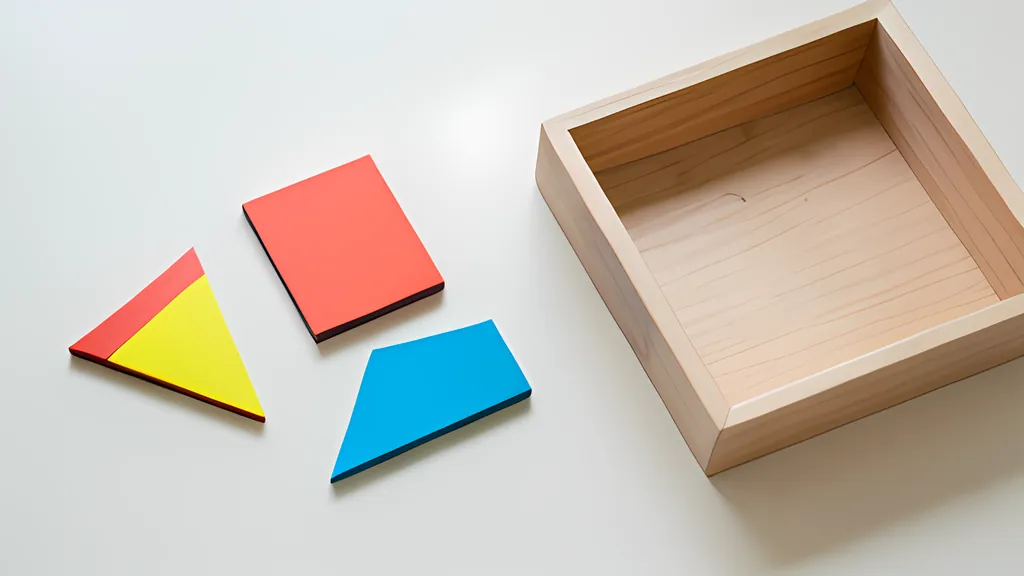
A tangram is a square cut into seven flat pieces: five right triangles in three sizes, one small square and one parallelogram. The game is to take a silhouette, a cat or a boat or a plain rectangle, and rebuild it with all seven, flat on the table, none overlapping. It takes a minute to explain and can take an evening to do.
The puzzle usually arrives with a story attached. A god named Tan, or a tile dropped by a servant, or seven books written in China four thousand years ago. None of it survives a look at the record. The tangram is a product of roughly the year 1800, and the part of it that deserves the word ancient is the geometry inside it.
A legend with a known author
The four thousand years can be traced to a man. Sam Loyd, the American puzzle maker, published The Eighth Book of Tan in 1903, a collection of 700 figures wrapped in a mock history of seven earlier books. Henry Dudeney, his English rival, repeated the four thousand years in his own book, and then did something useful: he printed what happened when a scholar checked.
The scholar was Sir James Murray, the dictionary editor at Oxford, who wanted an origin for the word after Dudeney’s magazine article of 1908. He asked a son teaching in Tientsin, the Chinese professor at Oxford and the Chinese Legation in London. His letter, which Dudeney quotes at length, reports that the man Tan, the god Tan and the Book of Tan are entirely unknown to Chinese literature, history or tradition. The puzzle was well known in China, he wrote, under a name meaning roughly a figure of seven ingenious pieces. No name like tangram occurred in Chinese at all.
Murray guessed that the English word was invented by an American some time after 1847 and before 1864, when it reached Webster’s dictionary. Later research summarized by Wikipedia points to Thomas Hill, a mathematician who would become president of Harvard, in a book for children printed in 1848.
What the record does hold is recent. The earliest known Chinese book of tangram figures is dated 1813 in the history page read for this essay. A set given to a Philadelphia merchant in 1802 is described as the earliest surviving one. An American ship carried a pair of Chinese books home, reaching Philadelphia in 1816, and the first tangram book published in America was based on that pair. In England a book called The Fashionable Chinese Puzzle, sold with a separate key of solutions, carried the fashion on to the rest of Europe.
A craze followed. Dudeney owned a copy of The Fashionable Chinese Puzzle, published by J. and E. Wallis, which advertised that the exiled Napoleon passed hours a day on it. Denmark had two books in 1818. A second wave came in Germany around 1891, when the industrialist Friedrich Richter sold stone sets as the Anchor Puzzle, and another during the First World War.
So the honest summary is short. The tangram was probably invented in China near the end of the 18th century, by someone whose real name is not known, and it crossed the oceans on trading ships within a generation. Everything older is storytelling.
Why the sides involve the square root of two
Every triangle in the set is an isosceles right triangle, a square cut along its diagonal. If its two legs have length 1, its hypotenuse has length equal to the square root of two, about 1.41421. That number cannot be written as a fraction, and the whole character of the puzzle follows from that fact.
Take the usual cut of a square of side 4. The two large triangles have a hypotenuse of 4 and legs of 2 times the root of two. The medium triangle has legs of 2. The two small triangles have a hypotenuse of 2 and legs equal to the root of two. The square has sides equal to the root of two, and the parallelogram has sides of 2 and the root of two. Every length is a whole number, or a whole number times that one stubborn constant.
Because the constant is not a fraction, the two kinds of side never trade places. A side of length 2 can sit against two short legs only if those legs measure 1 each, and they do not; they measure 1.41. This is why a tangram figure feels so constrained: pieces line up in two incompatible rulers at once, one for sides along the grid and one for sides across it. It is also why a careful program can do the arithmetic without rounding. Every corner of every piece, at any multiple of 45 degrees, is a number of the form a plus b times the root of two, and such numbers can be added, multiplied and compared exactly.
Area is simpler. Measure in small triangles and the pieces come to 1, 1, 2, 2, 2, 4 and 4, which makes 16 triangles for the 7 pieces together. Recreational mathematicians call shapes built from such triangles polyaboloes, a name coined from the diabolo, the juggling toy. Every tangram figure whose pieces share one grid is a polyabolo of 16 cells.
One piece is odd. A triangle or a square has a mirror line, so its reflection is just the same piece turned. The parallelogram has no mirror line, only a half turn. Its mirror image is a different shape, and it is the only piece that ever needs to be lifted and flipped over.
Thirteen shapes with no dents
Ask how many silhouettes the set can make and the answer is unbounded; the count of published problems alone runs into the thousands. Ask for the convex ones, the outlines with no dent anywhere, and the answer is exactly thirteen.
That was proved in 1942 by Fu Traing Wang and Chuan-Chih Hsiung, two mathematicians at the National University of Chekiang, in a short paper in the American Mathematical Monthly. The result has two parts. Sixteen congruent isosceles right triangles can be joined into just 20 different convex polygons, none with more than eight sides. Of those, the seven tans can build 13 of 20: one triangle, six quadrilaterals, two pentagons and four hexagons.
The seven failures are instructive. Several are long strips and thin parallelograms, too narrow for a large triangle to lie in at all. A different seven-piece puzzle of the same area, the Japanese Sei Shonagon Chie no Ita, manages 16 of the 20, and later work showed that no seven-piece set can make all 20.
A reader can repeat the second part. In the tool on this page, choose the set called Cannot be made, pick an outline and press Solve. The search tries every piece in every turn at the lowest empty corner, runs out of options after a few thousand placements at most, and reports that no arrangement exists. For the square, Count all finds 8 arrangements, which are one arrangement seen in its 8 turns and reflections.
Paradoxes that are only arithmetic
Dudeney’s best tangram joke is a pair of figures, two men in hats, identical except that one has a foot and the other does not. Both use all seven pieces. Where did the foot go?
Nowhere. Both figures have the same area, because both are made of the same pieces. In the footless figure the body is built from four pieces instead of three and comes out slightly larger; the extra strip along its side has exactly the area of the missing foot. The eye does not see it, because a difference between 1.41 and 1.5 units is hard to judge without a ruler.
Loyd’s book has others: a cup that appears whole, then with a hole, and a square that keeps its seven pieces after a corner is clipped off. Each is the same trick, and an exact check dissolves it at once. Two silhouettes made from one set always enclose 16 triangles each. If one seems to contain the other with room to spare, they are not the same size, and a program that compares outlines exactly rather than by eye will refuse to accept one as a solution of the other.
In the classroom, and on paper
Hill argued for the puzzle’s use in education, and teachers still use it. One study read for this essay followed 221 third grade pupils in Malaysia who spent three hours learning two-dimensional geometry and symmetry with tangrams. Their scores on a test of geometric thinking rose between the test before and the test after, most of all among the pupils of lower ability. It was a single group with no comparison class, so it should not be read as proof of an effect.
Making a set is a good first lesson. For a 120 mm square, mark the midpoints of two neighboring sides and join them: that cuts off the medium triangle, with legs of 60 mm. Draw the diagonal that does not touch that corner, then the other diagonal from the far corner only as far as the first cut. Two short cuts finish the job. The large triangles have legs of 84.9 mm and a 120 mm hypotenuse; the small triangles, the square and the short sides of the parallelogram all measure 42.4 mm. Each small triangle covers 900 square millimeters, a sixteenth of the sheet.
Print at full size and check a printed ruler before cutting, since a printer set to fit the page will shrink it. Thin card works; so does 3 mm plywood, though a saw removes its own width from every cut and the pieces will come out a little small.
An exact tangram has limits worth stating. Pieces here turn only in steps of 45 degrees, so a figure with a piece tilted at some other angle cannot be built or checked. The difficulty label is a rule of thumb, counting corners of the outline on the theory that fewer corners give fewer clues. And a solved silhouette says nothing about whether the figure looks like a cat. That judgment still belongs to the person holding the pieces.
Sources
Every source consulted for this guide. Links checked October 7, 2026.
- Tangram Wikipedia
- Polyabolo Wikipedia
- Special right triangle Wikipedia
- Square root of 2 Wikipedia
- A006074 - OEIS The On-Line Encyclopedia of Integer Sequences
- The complete characterization of tangram pentagons Sarah Sophie Pohl and Christian Richter, arXiv
- The Convex Configurations of 'Sei Shonagon Chie no Ita' and Other Dissection Puzzles Eli Fox-Epstein and Ryuhei Uehara, arXiv
- Determining the essentially different partitions of all Japanese convex tangrams T. G. J. Beelen and T. Verhoeff, arXiv
- A245676 - OEIS The On-Line Encyclopedia of Integer Sequences
- The Project Gutenberg eBook of Amusements In Mathematics, by Henry Ernest Dudeney Project Gutenberg
- The 8th book of tan; 700 tangrams Sam Loyd, hosted by the Internet Archive
- Chuan-Chih Hsiung (1915 - 2009) - Biography MacTutor History of Mathematics, University of St Andrews
- History of the Tangram University of Georgia, Department of Mathematics Education
- Facilitating Students' Geometric Thinking through Van Hiele's Phase-Based Learning Using Tangram Nyet Moi Siew, Chin Lu Chong and Mohamad Razali Abdullah, Journal of Social Sciences 9(3), 2013 (open access, Creative Commons Attribution)