The guide
A crystal lattice is made of points, and the atoms are a separate decision
Fourteen lattices describe every way a pattern can repeat in space. What sits on the points, how the planes are named and how X-rays read their spacing are three further questions.
- 14 Bravais lattices in three dimensions
- 0.7405 densest packing of equal spheres, pi over 3 root 2
- 1611 Kepler states the packing conjecture
- 11 November 1912 Lawrence Bragg presents his reflection condition
- 43.54 degrees 2 theta for copper (111) with copper K alpha 1
Read the full guide Fold the guide
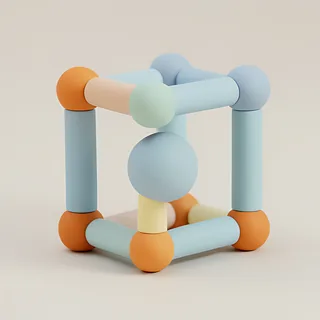
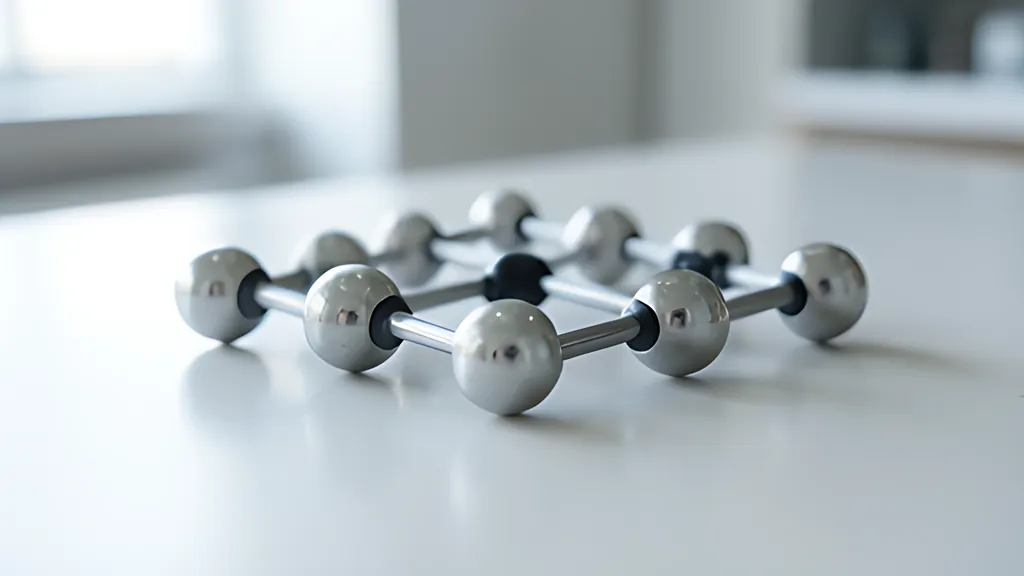
Pick up a ball-and-rod model of a crystal and you are holding two ideas glued together. One is a pattern of repetition: step this far in this direction and the surroundings look exactly as they did before. The other is a decision about what to put at each repeat. Most confusion about crystals comes from treating the two as one thing.
The pattern alone is the lattice. It is an infinite array of points, each of which sees the same arrangement of neighbours as every other. No atom is implied. A lattice point is a place where the pattern repeats, and a crystal structure is what you get when the same small group of atoms, called the basis, is set down at every point.
Fourteen ways to repeat
How many truly different patterns of repetition can three-dimensional space hold? The answer carries the name of Auguste Bravais, a French physicist born in 1811, and the date attached to his work is 1850. There are 14, and in the plane there are only 5.
The 14 come from two choices. First there are seven lattice systems, sorted by the shape of the box that repeats: triclinic, monoclinic, orthorhombic, tetragonal, rhombohedral, hexagonal and cubic. Each one is a rule about the box. A cubic cell has three equal edges and three right angles. A tetragonal cell lets one edge differ. A hexagonal cell keeps two equal edges at 120 degrees with the third standing upright. A triclinic cell obeys no rule at all.
Second, extra points may be added inside the box without spoiling its symmetry: one at the body centre, one on every face, or one on a single pair of opposite faces. Seven systems times four kinds of centring would give 28, but most combinations either repeat a pattern already listed or break the symmetry they were meant to keep. A body-centred monoclinic lattice, for example, turns out to be a base-centred one described with different axes. Fourteen survive.
The six numbers that fix a cell are the edge lengths a, b and c and the angles between them, with alpha between b and c, beta between a and c, and gamma between a and b. Not every trio of angles closes into a box. Try 60, 60 and 130 degrees: the third edge would have to stand 60 degrees from two edges that are themselves 130 degrees apart, which no direction can do, and the volume formula asks for the square root of a negative number. A tool that accepted such a cell would be drawing nothing real.
The cell you draw is not always the smallest
A primitive cell holds exactly one lattice point and is the smallest box that tiles the lattice. It is also, quite often, an awkward shape that hides the symmetry. So crystallographers draw a conventional cell instead: the smallest box that shows the full symmetry, even when it holds two, three or four lattice points.
Counting those points is a small exercise in sharing. A point at a corner belongs to eight neighbouring cells, so each cell owns an eighth of it. A point on a face is shared by two cells. A point inside belongs to one. The face-centred cubic cell has eight corners and six faces, which gives eight eighths plus six halves: four lattice points. The body-centred cell gives eight eighths plus one: two.
The same arithmetic counts atoms once a basis is added, and this is where lattice and structure part company. Diamond has a face-centred cubic lattice, but two carbon atoms sit at every lattice point, a quarter of the way along the cell’s body diagonal apart. That makes eight atoms in the cell, each with four neighbours. Hexagonal close packing is not a Bravais lattice at all: its atoms occupy two kinds of position, so it is a hexagonal lattice carrying a two-atom basis.
Caesium chloride makes the point from the other side. Ignore the difference between the two ions in caesium chloride and the positions look body-centred cubic, yet the lattice is simple cubic, because a step from a corner to the centre lands on a different kind of ion. The pattern does not repeat there.
Naming planes by where they cut
Diffraction treats a crystal as stacks of flat sheets of atoms, so planes need names. The scheme in use was introduced in 1839 by the British mineralogist William Hallowes Miller, although the German mineralogist Christian Samuel Weiss had used an almost identical one since 1817.
A Miller index is built from intercepts. Find where a plane cuts the three cell edges, measured as fractions of a, b and c, and take the reciprocals. A plane cutting all three axes one cell out is (111). A plane cutting a at one cell and running parallel to the other two is (100), because a plane that never meets an axis has an intercept at infinity and the reciprocal of that is zero. The three numbers name a whole family of parallel, evenly spaced planes, not one sheet.
The useful quantity is the spacing between neighbouring planes of the family, written d. In a cubic cell it has a formula every student meets: the edge divided by the square root of h squared plus k squared plus l squared. That formula is true only for cubes. Take a hexagonal cell with a = 1 and ask for the (100) spacing. The cubic rule answers 1. The real distance is 0.8660, because the a and b axes meet at 120 degrees and the planes are tilted against them.
The general answer goes through the reciprocal lattice, a second lattice whose axes are each perpendicular to two of the cell edges. The vector made from h, k and l steps along those axes stands at right angles to the planes, and its length is one over d. That one statement covers all seven systems, and the separate formulas printed for tetragonal, orthorhombic, hexagonal and the rest are just what it becomes when the angles are filled in. It also explains a trap: the direction written with the same three numbers as a plane is perpendicular to that plane in a cubic crystal and usually not in any other.
How tightly can spheres sit
Treat each atom as a hard ball that touches its nearest neighbours and ask what fraction of space the balls fill. In a simple cubic stack each ball touches six others and the answer is pi over 6, about 0.52. Body-centred cubic, with eight neighbours, reaches about 0.68. Face-centred cubic and hexagonal close packing, with twelve neighbours each, both reach pi over 3 root 2, which is 0.7405 to four places. Diamond, with only four, fills about 0.34.
That top figure has a long history. In 1611 Johannes Kepler, prompted by questions about stacking cannonballs that had passed from Walter Raleigh to Thomas Harriot and on to him, proposed that no arrangement of equal spheres can do better. Proving it took until 1998, when Thomas Hales announced a proof that checked a very large number of cases by computer. Referees declared themselves 99 percent certain. A fully formal, machine-checked proof was completed by a team Hales led in 2014 and accepted by a journal in 2017.
The close-packed figure depends on an exact proportion. In the hexagonal arrangement the layers are spaced so that the height of the cell is the square root of 8/3 times its width, about 1.633. Stretch the cell and each ball keeps only six touching neighbours in its own layer; the six above and below drift away, and the filled fraction falls.
Reading the spacing with X-rays
Nobody measures d with a ruler. In 1913 Lawrence Bragg and his father William Henry Bragg described how crystals reflect X-rays strongly at particular angles, and Lawrence Bragg had presented the condition on 11 November 1912. Picture the crystal as a stack of mirrors a distance d apart. Waves bouncing from neighbouring mirrors travel paths that differ by twice d times the sine of the glancing angle. They reinforce when that difference is a whole number of wavelengths.
The rule works because X-ray wavelengths are comparable to atomic spacings, and it sets a hard limit: if the wavelength is more than twice d, the sine would have to exceed one and no reflection exists at any angle.
Here is one worked case. A table of lattice constants at 300 K lists copper as face-centred cubic with a = 3.597 angstrom. Nearest neighbours are then a over root 2 apart, 2.5435 angstrom, and the (111) planes are a over root 3 apart, 2.0767 angstrom. The K alpha line of copper is a frequent source in laboratory diffraction instruments, and the United States standards institute NIST lists its K alpha 1 component at 1.5405929 angstrom. Half the wavelength divided by d is 0.3709, the angle is 21.77 degrees, and the detector, which records twice that, should show a peak at 43.54 degrees. Load the copper row in the tool, set the wavelength, and those figures appear.
What this geometry cannot tell you matters as much. It says where a reflection may occur, not how strong it is, and in the centred cubic lattices some reflections the formula allows are forbidden by selection rules on the indices. The tool computes neither. Its spheres are ideal and equal, while real ions are not: the caesium ion is listed at 167 picometres and the chloride ion at 181. Its lattice parameters are single values taken from a table headed with a single temperature. Silicon shows how far the real measurement has gone: its lattice parameter is listed to ten significant figures, 5.431020511 angstrom, a precision that belongs to careful experiment and not to any drawing.
Sources
Every source consulted for this guide. Links checked October 11, 2026.
- Bravais lattice Wikipedia
- Auguste Bravais Wikipedia
- Crystal system Wikipedia
- Unit cell Wikipedia
- Crystal structure Wikipedia
- Miller index Wikipedia
- Reciprocal lattice Wikipedia
- Atomic packing factor Wikipedia
- Cubic crystal system Wikipedia
- Close-packing of equal spheres Wikipedia
- Hexagonal crystal family Wikipedia
- Diamond cubic Wikipedia
- Kepler conjecture Wikipedia
- A FORMAL PROOF OF THE KEPLER CONJECTURE Thomas Hales and 21 co-authors, Forum of Mathematics, Pi 5, 2017 (OpenAlex record)
- Bragg's law Wikipedia
- Lattice constant Wikipedia
- Characteristic X-ray Wikipedia
- CODATA Value: lattice parameter of silicon National Institute of Standards and Technology
- X-ray Transition Energies - Search Result National Institute of Standards and Technology (query: copper, K L3)
- XYZ file format Wikipedia