
The guide
The Soroban Never Adds Seven: It Takes Off Three and Hands One to the Rod on the Left
The Japanese abacus has five beads to a rod and two tiny sets of number pairs. That is the whole method, and it is why the sums run from left to right.
- 23 rods the standard Japanese frame today, per the abacus league
- 1938 soroban technique enters national arithmetic textbooks
- 4 + 3 = 4 + 5 - 2 a five-complement, written as the beads move
- 9 + 7 = 9 - 3 + 10 a ten-complement, written the same way
- 1.7 seconds a champion's time to add fifteen flashed three-digit numbers
Read the full guide Fold the guide
A soroban has no way to add seven to nine. There are not enough beads on the rod, and the operator does not stop to work out that the answer is sixteen. The hand takes three beads off and pushes one bead up on the next rod to the left, and sixteen is simply what the frame then shows. Nobody added anything. Two small facts were recalled and beads were moved.
That is the idea worth learning, and it is easy to miss when the instrument is treated as a curiosity. The soroban is a deliberately poor counting device. It carries fewer beads than the abaci it descends from, on purpose, and the shortage is what forces a method that is fast. Learn the method and the frame becomes optional.
Fewer beads, on purpose
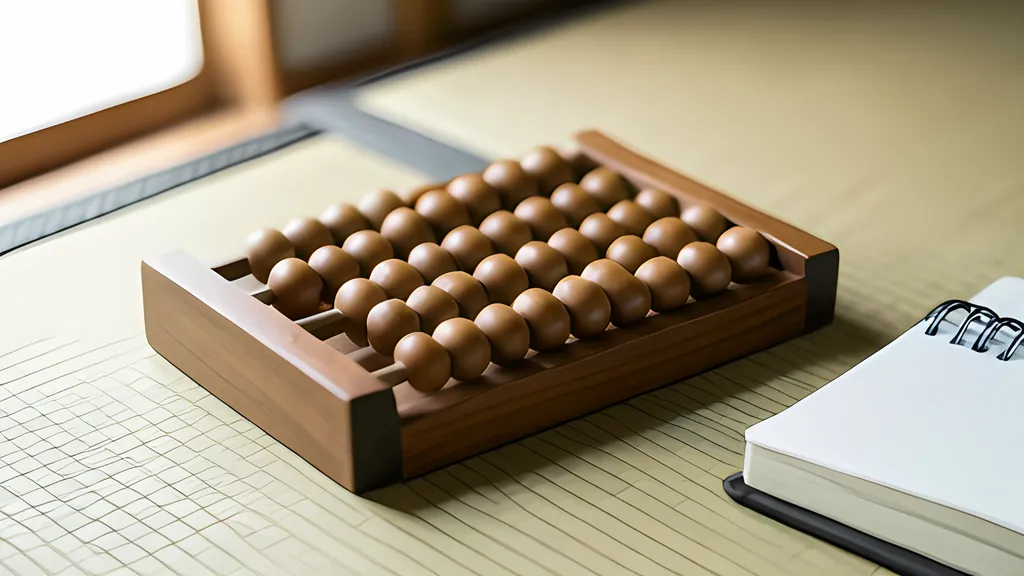
The League of Japan Abacus Associations describes today’s standard instrument as a wooden frame 33 by 6 centimeters with 23 rods of five beads each, 1 above the bar and 4 below. A bead above the bar is a five. A bead below is a one. Beads count when they are pushed to the bar, so a rod with its upper bead down and two lower beads up reads seven. Each digit from zero to nine has exactly one arrangement.
It did not start that lean. The Chinese suanpan, with two beads above the bar and five below, has seven beads to a rod where the soroban has five. Takashi Kojima, whose 1954 manual taught the method to English readers, dates that bead abacus to probably the twelfth century, with common use by the fourteenth. The league’s own history places its popular spread in the Ming dynasty. The Chinese practice, called Zhusuan, was inscribed on UNESCO’s Representative List of the Intangible Cultural Heritage of Humanity in 2013.
How the instrument reached Japan depends on whom you ask, and the honest course is to give the dates as each source does. The league says the Chinese abacus arrived a little past the middle of the fifteenth century. Japan’s National Diet Library points to a dictionary printed in the 1590s that already had an entry for soroban, and to a diarist of the 1650s who wrote that his elders seemed to have calculated with rods, which was beyond his imagination. A page kept at Toronto Metropolitan University says about 1600, by way of Korea.
The books that spread it are better documented. The library credits Jinkoki, first issued in 1627 by Yoshida Mitsuyoshi as a manual for the soroban, with carrying the four operations to a wide public. It was popular enough to be imitated for generations.
Then came the pruning. Kojima writes that toward the close of the nineteenth century the two upper beads were reduced to one, and that around 1920 a lower bead was dropped as well. The Toronto page puts the one-over-four frame at about 1930. The league says the four-bead type came into use toward the end of the nineteenth century alongside the older one, and adds a date that is not in dispute: in 1938 soroban technique entered the national arithmetic textbooks.
Reading a number, and the dots on the bar
Every third rod carries a small dot on the bar, which the league calls a unit point. Pick one as the ones place and the rods to its left are tens, hundreds and thousands, with the next dot marking the thousands the way a comma would. Kojima tells the reader always to set the last digit of a number on a rod marked with a point. Rods to the right of it are free for decimals.
Zero is not a symbol on this instrument. It is a rod with every bead away from the bar. The league’s instructions for clearing the frame are physical: tilt it toward you so the lower beads fall, lay it flat, and run a forefinger between the upper beads and the bar from left to right.
Setting a number already uses the working direction. In 3,068 the three goes on first, then nothing, then the six, then the eight. You place digits in the order you say them.
Two families of pairs are the whole trick
Adding on one rod is easy until the beads run out. Put four on a rod and try to add three. There is only one lower bead left. The move that works is to bring down the five and push two away, and Kojima writes it as an equation: 4 + 3 = 4 + 5 - 2. He calls the two the complementary digit of three for five. There are only two such pairs to remember: four with one, and three with two.
The second shortage comes at ten. With nine on a rod there is no room for seven. Seven and three make ten, so take three off this rod and add one bead on the rod to the left: 9 + 7 = 9 - 3 + 10. The pairs for ten are nine and one, eight and two, seven and three, six and four, and five with itself.
Sometimes both happen together. Six plus six needs four taken off, and a rod showing six has only one lower bead up. So one bead goes up, the five goes away, and a bead rises on the left: plus one, minus five, plus ten. Subtraction runs each of these backward. Sixteen minus seven takes the ten off first and then adds three.
That is all there is. Every pair of digits falls into one of four cases: the beads are there, or the five must help, or the ten must help, or both. The Toronto page prints the cases for addition as four tables. Kojima lists them example by example. The tool on this page works them out from the beads instead and arrives at the same assignments, apart from a few entries the printed lists leave out or repeat.
Kojima is blunt about how to use them. Do not think that three and four are seven and then build a seven, he says. Remember the complement, move the beads, and let the sum form itself. He calls this mechanization, and he means it as praise: the mind handles one small fact at a time and the frame holds everything else.
Left to right, and what it buys
Paper arithmetic starts at the right because carries flow leftward. The soroban starts at the left anyway. The league lists this among the first things a foreign student is told: in addition and subtraction, calculations run from the highest digit to the lowest, unlike calculation on paper. Kojima gives the reason. A number is spoken from its highest digit, so on the abacus to set a number is to calculate it while it is still being read out.
Try 14 + 28 on the frame above. Set one on the tens rod and four on the ones rod. Add two on the tens rod, which is direct, and the frame reads 34. Now add eight on the ones rod. Four has no room for eight, so take two off and add one on the tens: 42. Four steps, and no moment where anything had to be held in the head.
Carries that run are handled the same way. For 996 + 7, Kojima has the hand form three on the ones rod and then travel straight left, clearing each nine and setting one on the thousands rod. One rule, applied again on each rod it reaches.
The method has limits, and they should be said plainly. It carries no record of what was entered, so a slip is invisible afterward and the only check is to do the sum again. A result too wide for the rods simply cannot be shown. Multiplication and division exist and Kojima teaches them, but they rest on these same additions and subtractions plus a memorized times table, and nothing on this page covers them.
From the frame to the head, and to the classroom
Practiced operators stop needing the wood. Kojima describes mental calculation as visualizing an abacus and working the problem by the standard method on the imaginary instrument, and the league’s vocabulary list has a word for it, anzan. It also lists yomiagezan, sums read aloud, which begin with a set phrase and end with a shout of gomeisan from those who got it right. This essay makes no claim about what such practice does beyond arithmetic.
The public face of that skill is Flash Anzan, an event at the All Japan Soroban Championship. There, with no instrument in hand, one champion added fifteen three-digit numbers in 1.7 seconds. The drill on this page borrows the format and none of the speed. It changes its number at most twice a second, well inside the web accessibility guideline that warns against content flashing more than three times in any one second.
Institutions grew around the instrument. The league dates proficiency tests to 1928 and the official examination of the Japan Chamber of Commerce and Industry to 1944, and says the 1989 school curriculum extended soroban study from the third grade into the fourth. Its phrase list admits that this amounts to about eight hours a year. A machine once lost to it in public: in Tokyo in 1946 a soroban beat an electric calculator in four of five rounds.
To practise, go in the order the shortages appear. Start with sums where the beads are always there, until setting and clearing are thoughtless. Add the pairs for five, then the pairs for ten, then mix them. Work columns of longer numbers from the top. Use the same seed to repeat a set and watch the time fall. Only then try numbers shown one at a time.
Sources
Every source consulted for this guide. Links checked October 5, 2026.
- SOROBAN The League of Japan Abacus Associations
- History of the Soroban The League of Japan Abacus Associations
- Preliminary Knowledge The League of Japan Abacus Associations
- Soroban in Education and Modern Japanese Society The League of Japan Abacus Associations
- Soroban-Related Words in English The League of Japan Abacus Associations
- The Japanese Abacus: Its Use and Theory Takashi Kojima, Charles E. Tuttle Company, full text at the Internet Archive
- The Abacus: Addition Luis Fernandes, Toronto Metropolitan University
- The Abacus: A Brief History Luis Fernandes, Toronto Metropolitan University
- The Abacus: A Brief Introduction Luis Fernandes, Toronto Metropolitan University
- Chapter 1. Early Edo Period | Japanese Mathematics in the Edo Period National Diet Library, Japan
- Suanpan Wikipedia
- Mental abacus Wikipedia
- Understanding Success Criterion 2.3.1: Three Flashes or Below Threshold W3C Web Accessibility Initiative