
The guide
Flag semaphore is a clock face you wear, and it only works if you know who is looking
Two flags and eight directions carry the whole alphabet, the code is laid out in circles, and the oldest mistake in it is reading a signal from the wrong side.
- 45 degrees the step between the eight positions an arm can take
- 28 pairs the ways two flags can point in different directions
- 1822 the year the Admiralty's semaphore line to Portsmouth opened
- 17 words per minute a record fleet message quoted by Britannica in 1911
- 10 mirror pairs letters that turn into another letter when seen from behind
Read the full guide Fold the guide
Stand with a flag in each hand and you become a clock with two hands. Each arm can point in one of eight directions, a step of 45 degrees apart, and the pair of directions you choose is a letter. That is the entire machine. There is no battery in it, no wire and nothing to tune, and in practised hands it was once the everyday way for the ships of a fleet to talk to each other.
The catch is that a clock looks different from the back. Flag semaphore has a small, tidy code and one stubborn difficulty, and the difficulty is not memory. It is point of view. Almost everything that goes wrong for a learner comes from forgetting whether a picture shows what the sender does or what the receiver sees.
From towers to arms
The idea is older than the flags. Claude Chappe, born at Brulon in France in 1763, built what the 1911 Encyclopaedia Britannica calls an optical telegraph: an upright post with a bar across the top and a smaller arm pivoted at each end of the bar. The positions of the bars stood for words or letters. Stations were set where each could be seen from the next, and by Britannica’s account a message could travel 50 leagues in a quarter of an hour. The French Legislative Assembly adopted the machine in 1792.
The same encyclopaedia notes that the word telegraph was first used for visual devices of exactly this kind, long before it meant anything electrical. A telegraph, to begin with, was something you looked at through a telescope.
Britain’s Admiralty first used a chain of shutter stations during the Napoleonic Wars. According to the Science Museum Group, the shutter stations closed in 1816 and the design chosen to replace them came from Rear Admiral Sir Home Riggs Popham, whose earlier code of signals the Admiralty had adopted in 1803. His semaphore had two arms on a mast 30 feet high. Each arm could take seven positions, which gives 49 signals.
A trial line to Chatham was built in 1818, and the line from the Admiralty to Portsmouth opened in 1822, two years after Popham died. It could pass a message along its 108 km in about 15 minutes, and it worked until 1847, when the railway and the electric telegraph took over.
The towers went. The idea of two arms did not. By the time Britannica described naval signalling in 1911, a semaphore signal was made by the extension of a man’s arms through a vertical plane, usually with a small flag on a stick in each hand to make the arms easier to see. Ships still carried mechanical semaphores as well, and for long range a large one at the masthead with arms 9 to 12 feet long. But the ordinary message work of a squadron went by hand, because hoisting flags was slow. Britannica gives a record: 350 words sent to 21 ships at once at 17 words per minute.
A code built in circles
Two hands and eight directions give 64 combinations, but most of them are useless or duplicates. A receiver cannot tell which hand holds which flag, so only the two directions matter. Put both flags in the same direction and they hide each other. What is left is the number of ways to choose two different directions out of eight, which is 28 pairs. The alphabet needs 26. The two spare pairs became the numerals sign and the annul sign, and nothing is wasted.
The pairs are not handed out at random. Hold one flag straight down and step the other round the clock, one position at a time, starting just beside it: that gives A, B, C, D, E, F and G. This is the first circle. Now park the still flag one step round, at the low position on the signaller’s right, and step the other flag again from the next position on. That gives H, I, K, L, M and N, six letters, because one position is already taken. The third circle has five, then four, three, two, and finally one: Z.
Britannica’s 1911 figure sets the code out in exactly these rows, and so does the United States Army’s 1910 manual of visual signalling, which prints the navy’s two-arm alphabet as a page of small drawn sailors. The rows are the same in both. Count the rows: 7 and 6 and 5 and 4 and 3 and 2 and 1 make 28.
The circles explain the code’s one oddity. J is missing from the second circle, where the alphabet says it should be, and V is missing from its place in the fourth. Both turn up in the fifth circle beside the numerals sign, and Y takes V’s old seat. Nobody learning the code should fight this. Learn where J, V and Y sit, and the rest falls out of counting.
Figures, words and mistakes
There are no separate signals for digits. Instead the code borrows letters. After the numerals sign, A to I stand for 1 to 9 and K stands for 0, a convention both the 1910 manual and Britannica’s figure print directly under the drawings. J then does a second job: sent after figures, it means letters follow.
A worked example shows the whole system. Take the message DECK 7. D is one flag up and one down. E is a flag high on the signaller’s left with the other down. C is its mirror, high on the right. K is low on the right and straight up. Then the flags cross low in front of the body, which ends the word.
Then comes the numerals sign, straight up and high left, and finally G, which now means 7. That is seven signals for five characters. Written as arm positions numbered 0 to 7 from straight down, right arm first, it reads 40 05 30 14 00 45 07, and typing that line into the translator gives the message back.
The manuals are less unanimous about the signals around the message than about the letters in it. The 1910 manual ends each word by bringing the flags across the lower part of the body, ends a message by holding both arms out level and waving, and shows the error signal as both flags waved above the head. Britannica labels the crossed position Ready. The drawings most people meet today, the set on Wikimedia Commons used by Wikipedia, call that position rest or space and show error as both arms swung up and down together.
None of this is a contradiction so much as a reminder. Semaphore was a working practice in several services over more than a century, not a single published standard, and its procedure drifted where its alphabet did not. A trainer has to pick one convention and say which.
The wrong side of the signaller
Now the difficulty. Every chart of the code has to choose a side. Britannica’s caption is blunt about it: the signaller invariably faces his reader, because otherwise each letter might be read as its opposite, and the figure shows the signals as they appear to the reader. The drawings in the 1910 manual and on Wikimedia Commons do the same. A chart, in other words, is nearly always the receiver’s view.
So a learner who copies a chart with their own arms, matching left to left, sends the mirror image of every signal. Sometimes that does no harm. D, N, R and U are symmetrical and look the same from either side. But A becomes G, B becomes F and C becomes E, and in all there are 10 mirror pairs among the letters: A and G, B and F, C and E, H and Z, I and X, J and P, K and V, M and S, O and W, Q and Y. Two more letters turn into signs. L mirrors to annul and T to numerals.
This is why practice has to be done in both directions and why a tool that shows only one view teaches half the skill. Reading means recognising a shape made by someone facing you. Sending means making the opposite shape with your own body and trusting it. The two do not transfer automatically, any more than reading a language makes you able to speak it.
Where it went
Radio ended semaphore as a main channel, but not altogether. An education sheet from the United States Naval Undersea Museum says flag semaphore was adopted and widely used in the maritime world in the 19th century, is still used during underway replenishment at sea, and is acceptable for emergency communication in daylight, or at night with lighted wands instead of flags. A United States Navy photograph dated July 9, 2025 shows a quartermaster seaman aboard the aircraft carrier Gerald R. Ford handling a semaphore flag during a replenishment at sea from a supply ship.
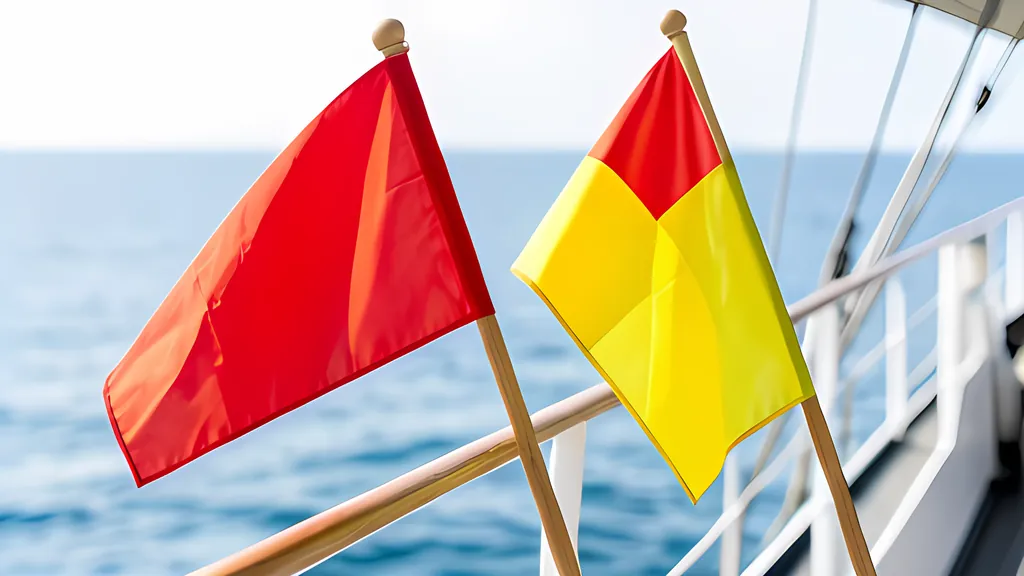
Flag colours are part of the lore. Red and yellow at sea and blue and white on land is the usual statement, and Wikipedia repeats it, though the sentence there is marked as lacking a reference. Treat it as custom. The code does not depend on it, and flags are not required at all.
The code also has an afterlife in jokes and in protest. An April 2007 document in the internet’s RFC series solemnly specifies how to carry network traffic by flag semaphore, with typewriter drawings of each letter as seen from the receiving side. And in 1958 the designer Gerald Holtom drew a symbol that first appeared in public on that year’s Easter march from London to Aldermaston, where British nuclear weapons were made. The Campaign for Nuclear Disarmament records his explanation that it combines the semaphore letters N and D inside a circle: both flags low for N, one up and one down for D.
It is a fitting pair of letters. N and D are both symmetrical, so the peace symbol is the same signal whichever side of the march you stand on.
What semaphore cannot do is just as plain. It needs daylight or lights, a clear line of sight, and a reader who is watching at the right moment. It carries no punctuation to speak of, and nothing is recorded unless someone writes it down. It is slow beside any radio. What it offers in return is a code small enough to hold in your head by the end of an afternoon, provided you always ask the one question first: who is looking?
Sources
Every source consulted for this guide. Links checked October 10, 2026.
- Visual Signaling, Signal Corps Manual No. 6 (1910) United States War Department, Office of the Chief Signal Officer (public domain; copy at the Internet Archive)
- 1911 Encyclopædia Britannica/Signal Wikisource (public domain text)
- 1911 Encyclopædia Britannica/Chappe, Claude Wikisource (public domain text)
- 1911 Encyclopædia Britannica/Telegraph Wikisource (public domain text)
- Dictionary of National Biography, 1885-1900/Popham, Home Riggs Wikisource (public domain text)
- Home Riggs Popham Science Museum Group Collection
- Collection of documents relating to the Portsmouth-to-Admiralty semaphore line designed by Sir Home Riggs Popham Science Museum Group Collection
- Flag semaphore Wikipedia
- File:Semaphore Alpha.svg Wikimedia Commons
- Decoding Semaphore U.S. Naval Undersea Museum, Naval History and Heritage Command
- USS Gerald R. Ford (CVN 78) Conducts Replenishment-at-Sea [Image 1 of 9] Defense Visual Information Distribution Service, U.S. Department of Defense
- History of the Symbol Campaign for Nuclear Disarmament
- RFC 4824: The Transmission of IP Datagrams over the Semaphore Flag Signaling System (SFSS) RFC Editor