
The guide
A moving truck runs out of weight, floor and order long before it runs out of cubic feet
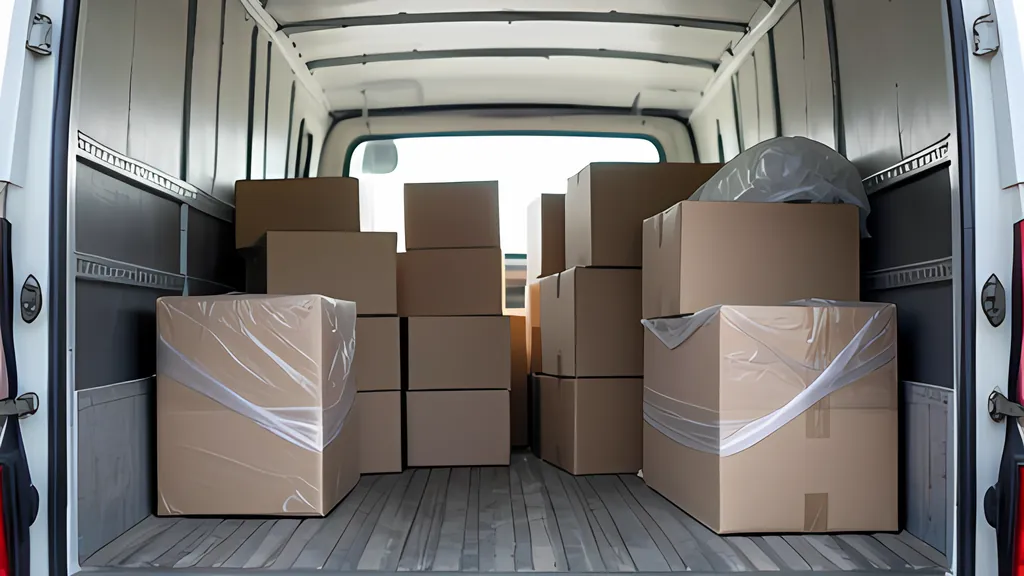
Cubic feet sell the truck, but payload, the shape of the furniture and the order it goes in decide what actually fits, so those are the things to plan first.
- 6,385 lb maximum load of a typical 15 ft rental truck
- 5,700 lb maximum load of the longer 20 ft truck
- 0.8 g forward deceleration cargo tiedowns must withstand
- 5,867 mm minimum inside length of a 20 ft ISO container
- 60 percent most cargo weight advised in one half of a container
Read the full guide Fold the guide
Every rental truck is sold by one number. Ten feet, fifteen, twenty-six: a length, with a volume in cubic feet printed beside it. It is an easy number to hold against a list of rooms, and it is the wrong place to start. A truck is a weight limit, a floor, a door and a sequence. Volume is what remains after those four have had their say. What follows traces a load from the rental counter to the last strap, then asks what a planning program can honestly promise about it.
The number on the side of the truck
U-Haul lists its 15 ft truck at 15 ft by 7 ft 8 in by 7 ft 2 in inside, and at 764 cubic feet. Multiply the three dimensions and the answer is 824. The 10 ft truck errs the other way: 9 ft 11 in by 6 ft 3 in by 6 ft 1 in comes to 377 cubic feet against a listed 402. The pages do not explain either gap. They do carry a plain notice that all measurements are approximate and that the equipment you receive may vary in size.
Nor does “26 ft” mean one thing. U-Haul’s 26 ft truck is 26 ft 2 in long inside, 8 ft 3 in high, and rated for a maximum load of 12,859 lb. Penske describes its own as up to 25 ft 11 in long and up to 8 ft 1 in high, with up to 10,000 lb of load capacity. Same name, three inches and 2,859 lb apart.
The door is smaller than the box behind it. That 15 ft truck stands 7 ft 2 in high inside, but its door opening is 6 ft 5 in. Anything taller must tip to get in, whatever the interior says.
Shipping containers are the one cargo space with a real standard behind the name. ISO 668 fixes the outside of a 20 ft box at 6,058 mm long and 2,438 mm wide, and it sets minimum inside dimensions: 5,867 mm of length, 2,330 mm of width and 2,350 mm of height for the common 8 ft 6 in tall box. Real boxes beat the minimum by a little. SeaCube’s standard 20 ft container measures 5,898 by 2,352 by 2,393 mm inside, behind a door opening of 2,340 by 2,280 mm, and its 40 ft container is 12,032 mm long with the same cross-section. Plan to the minimum and any conforming box will take the load.
Weight runs out first
Payload is not a property of the cargo box. Federal rules define the gross vehicle weight rating as the value the manufacturer specifies as the loaded weight of the vehicle, so what you may carry is whatever remains after the truck’s own weight. U-Haul’s figures show the subtraction. The 15 ft truck is rated at 14,500 lb gross and weighs 8,115 lb empty, which leaves a maximum load of 6,385 lb. The 20 ft truck has the same 14,500 lb rating and weighs 8,800 lb empty. Its box holds a third more by volume and may carry less: 5,700 lb.
So the longer truck can be the wrong answer for a heavy load. Books and tools want payload. Bedding and lampshades want space. The headline size describes only the second.
The arithmetic is easy to try. Take a box of books, 16 by 12 by 12 inches, and call it 40 lb. Enter 72 of them in the planner with the 10 ft truck selected. All 72 load in three feet of floor, and the space gauge reads 25 percent. The weight reads 2,880 lb against a limit of 2,850. The truck is three-quarters empty and already over.
Where the weight sits matters as much as how much there is. The same federal definitions give every axle its own rating, the load it can carry measured where the tires meet the road. On the Interstate system federal law limits a single axle to 20,000 lb, a tandem pair to 34,000 lb and the whole vehicle to 80,000 lb, and the bridge formula ties the allowed weight on any group of axles to the distance between them. A load can be legal in total and still too heavy at one end.
Containers make the point at a larger scale. SeaCube rates its 20 ft box for a payload of 28,360 kg and its 40 ft box for 28,970 kg: twice the space, 610 kg more cargo. Fully loaded, the 20 ft box has a gross weight of 67,197 lb, which leaves 12,803 lb of the federal 80,000 lb limit for the tractor and chassis under it. The rating on the door is a limit for the box, not permission for the road.
Inside the box, the international packing guidelines quoted in the German insurers’ Container Handbook ask for the cargo’s center of gravity near the middle of the length and below half the height of the space. They add a number: no more than 60 percent of the load should sit in less than half the length, and on a vehicle the axle loads deserve special attention.
Order is half the plan
Movers do not fill a truck. They build it. U-Haul’s loading guide names the unit of construction, the tier: a stacked row across the truck, tied off before the next one begins. Each tier gets a base of large furniture with flat surfaces. The heaviest things, the washer, the dresser, the couch, go in first, which puts them deepest in the truck, and boxes are stacked by the weight of what is inside, not by the size of the carton. The guide’s own example is exact: a small box of heavy books does not belong on a large box of pillows.
The same advice appears wherever freight is stacked. A Postal Service handbook on palletized mail asks for the weight on a pallet to be spread evenly, with denser products on the bottom, and caps the load at 72 inches overall. CHEP designs its standard 48 by 40 inch pallet to carry 2,800 lb as an evenly distributed load. Dense and low, light and high, tight against something solid: the rule does not change with the size of the platform.
Order also decides what can be reached. U-Haul wants the mattress in early, on its side against a wall, because it changes every row built after it. Rugs go in last so that they come out first. A plan that lists what fits but not when is half a plan.
A full truck still has to stop
A packed truck is not yet a secured one. The federal cargo securement rules are written for commercial trucks and trailers, not for a family in a rental, but the physics they describe is the same. Cargo must be contained, immobilized or secured so that it cannot shift enough to harm the vehicle’s stability or maneuverability. Then come the numbers. Tiedowns must survive 0.8 g of deceleration forward and 0.5 g to the rear and to either side. In a stop that hard, a 250 lb refrigerator leans on whatever is in front of it with 200 lb of force.
The rules also say how. Cargo is to be held by structures of adequate strength, dunnage, shoring bars, tiedowns or a combination of these, and articles strapped down side by side must touch or be kept from sliding toward each other. The tiedowns on an article need a combined working load limit of at least half its weight. With nothing blocking it in front, an article up to 5 ft long and 1,100 lb needs one tiedown, and a longer or heavier one needs at least two. This is the tier again, written as law: tight rows, each one strapped, the front wall doing the blocking.
For containers the reference is the CTU Code, a code of practice for packing cargo transport units developed jointly by the International Maritime Organization, the International Labour Organization and the United Nations Economic Commission for Europe and endorsed in 2014. It is not mandatory. It is addressed to the people who pack and secure a unit and also to the people who open it at the other end.
What a planner can and cannot promise
Fitting boxes into a bigger box sounds like a puzzle a computer should simply solve. It is not. Martello, Pisinger and Vigo, in their paper on three-dimensional bin packing, call the problem strongly NP-hard and extremely difficult to solve in practice, and they report exact results for instances of up to 90 items. Planners therefore lean on heuristics: sensible rules applied quickly. Crainic, Perboli and Tadei observed that results depend strongly on where each item is allowed to go, and proposed trying the “extreme points” thrown off by the corners of the items already placed.
The planner on this page works that way. It sorts the pieces and tries each one at those corner points, turned only in the ways you allow. A position counts only if the piece stays inside, overlaps nothing, rests at least 70 percent of its base on the floor or on pieces below, and sits on nothing lighter than itself or marked “nothing on top”. The 70 percent is this tool’s rule of thumb, not a standard. It repeats the job for several sort orders, keeps the fullest result, then reorders the load so each piece arrives after whatever carries it and before whatever would stand between it and the door.
Run its sample load to see the gap between volume and fit. A fridge, a sofa, a table, a mattress and 60 boxes in three sizes make 64 pieces weighing 2,630 lb. In the 15 ft truck all 64 load, using 132 of the 180 inches of floor and 42 percent of the space, which works out to about 346 cubic feet. Switch to the 10 ft truck, listed at 402 cubic feet, and the same 346 no longer go in: 62 pieces load, the gauge stops at 74 percent, and the table and the mattress stay on the driveway.
Be clear about what that result means. It does not prove the table cannot fit. A patient person may find room the rule missed, and a different rule might load the table and strand something else. The planner treats every item as a solid block, so the space under a table and between the arms of a sofa is lost. It does not know that the door is smaller than the interior, that a mattress wants a wall or that the rug should come out first. It adds up weight but computes no axle loads and no center of gravity, and it designs no strapping.
The research literature makes the same admission about itself. A 2013 review in the European Journal of Operational Research records the standing complaint that container loading methods are of limited practical value because they pay too little attention to the constraints met in practice.
Use the plan as a rehearsal. It shows which truck is too small and which is too weak, what goes in first, and how much floor is left over. The tape measure, the scale and the straps are still yours.
Sources
Every source consulted for this guide. Links checked October 3, 2026.
- 10ft Moving Truck Rental | U-Haul U-Haul
- 15ft Moving Truck Rental | U-Haul U-Haul
- 20ft Moving Truck Rental | U-Haul U-Haul
- 26ft Moving Truck Rental | U-Haul U-Haul
- Cargo Van Rental | Rent A Van Near You | U-Haul U-Haul
- How to Pack a Moving Truck (Or Portable Storage Container!) | U-Haul U-Haul
- 26 Foot Moving Truck Rental - Penske Truck Rental Penske Truck Rental
- 20' Standard Dry Containers SeaCube Container Leasing
- 40' Standard Dry Containers SeaCube Container Leasing
- ISO 668 - Wikipedia Wikipedia
- Pooled Wood Block Pallet, North America (48 x 40 inches) CHEP (specification sheet, copy hosted by Qimarox)
- Palletizing and Packaging United States Postal Service, Handbook PO-508
- eCFR :: 49 CFR Part 393 Subpart I -- Protection Against Shifting and Falling Cargo Electronic Code of Federal Regulations, U.S. National Archives
- eCFR :: 49 CFR 571.3 -- Definitions. Electronic Code of Federal Regulations, U.S. National Archives
- Bridge Formula Weights- FHWA Freight Management and Operations Federal Highway Administration
- IMO/ILO/UNECE Code of Practice for Packing of Cargo Transport Units (CTU Code) International Maritime Organization
- Container Handbook - Section 4.2.1.3 Stowage planning German Insurance Association (GDV)
- The Three-Dimensional Bin Packing Problem Operations Research (INFORMS), abstract at IDEAS/RePEc
- Extreme Point-Based Heuristics for Three-Dimensional Bin Packing CIRRELT, Interuniversity Research Centre on Enterprise Networks, Logistics and Transportation
- Constraints in container loading - A state-of-the-art review European Journal of Operational Research, abstract at IDEAS/RePEc