
The guide
Every turned shape is a stack of thin pieces, and the three ways to add them must agree
Spin a curve about a line and you get a vase, a bearing or a trumpet without end. Calculus measures each by cutting it into disks, washers or shells, and the cuts cannot disagree.
- 25.13 cubic units in the worked paraboloid, by disks, shells and Pappus
- two-thirds of its enclosing cylinder: the sphere, as Archimedes proved
- 1615 Kepler prints his study of the volumes of wine barrels
- V = 2 pi d A Pappus: area times the distance its centroid travels
- 1644 Torricelli publishes an endless solid with a finite volume
Read the full guide Fold the guide
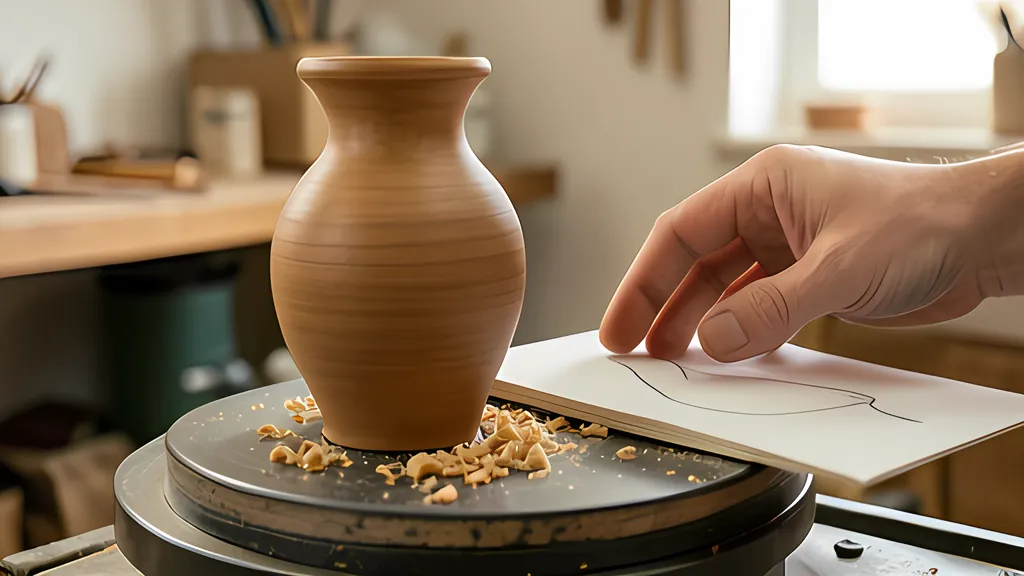
A lathe does one thing. It turns the work about an axis while tools are applied to it, and what comes off the machine has symmetry about that axis: candlesticks, table legs, bowls, baseball bats, gun barrels. Lathes can shape pottery too, and the best known of them is the potter’s wheel.
Mathematics has a plain name for the family. Take a flat region, turn it about a line in its own plane, and the space it sweeps is a solid of revolution. The workshop is full of them. Whatever comes off a lathe belongs to the family, because turning is how the lathe made it.
How much wood is left in the leg? How much water will the vase hold? No formula covers every profile. A method does.
Cut it into pieces you can measure
The method is to slice. Cut the solid into thin pieces square to its axis, measure each piece, and add them up along the length, which is the work an integral does. For anything turned on a lathe the pieces could not be simpler. Cut square to the axis and the face of the cut is a circle, so its area is pi times the radius squared. If the profile is the curve y = f(x), the radius at x is f(x), and the volume is pi times the integral of f(x) squared.
The idea is far older than the notation. Archimedes showed that a sphere has two-thirds the volume of the cylinder that just encloses it, and thought enough of the result to ask for a sphere and a cylinder on his tomb, where Cicero later found them. Another of his works measured segments of the solids made by turning a parabola, a hyperbola and an ellipse. The St Andrews history of mathematics says he perfected a method of integration, and that his work anticipated the integral calculus.
Eighteen centuries on, a wedding pushed the idea further. Johannes Kepler married for the second time in 1613, and at the celebrations he noticed that the volume of a wine barrel was estimated by slipping a rod in diagonally through the bung-hole. He began to wonder how that could work. The answer became a book, printed at Linz in 1615, on the volumes of solids of revolution. Kepler resolved his solids into what were called indivisibles. Bonaventura Cavalieri built that into a theory in 1635, treating a solid as an infinite set of parallel plane sections, and the same history counts it part of the ancestry of the calculus.
Disks, washers and shells
A disk is the slice of a solid that reaches its axis. When the region stands off from the axis the slice has a hole in it, and the piece is a washer: the area of the big circle minus the area of the small one. The tool’s Washer preset turns the sliver between y = x and y = x squared, from 0 to 1, about the x-axis. The outer radius is x and the inner one is x squared, so the sum is pi times the integral of x squared minus x to the fourth: a third less a fifth, times pi, or 2 pi/15.
There is another way to cut. Instead of slicing across the axis, take a thin strip that runs parallel to it. Turned about the axis, the strip sweeps a tube, a cylindrical shell like a tin with both ends removed. Its volume is very nearly three lengths multiplied together: the height of the curve at that point, the circle the strip travelled, 2 pi x, and the thickness of the strip. Add the shells. The region under y = x squared from 0 to 1, turned about the y-axis, is 2 pi times the integral of x cubed, which is 2 pi times a quarter, or pi/2.
Which to use? Usually whichever leaves the easier integral. Take one arch of the sine curve, y = sin(x) between 0 and pi, and turn it about the y-axis. Shells need one integral in x, of x times sin(x), which comes to pi, and give 2 pi squared, about 19.74. Washers would need the arch solved for x, and it has two branches.
Neither method owns the solid. They are two ways of cutting one object, and one object has one volume.
One paraboloid, three sums
A worked case makes the point better than an assurance. Turn y = sqrt(x), from x = 0 to x = 4, about the x-axis. It is the shape the tool above opens with, a blunt bullet 4 units long and 4 across at its flat end. By disks, the radius at x is the square root of x, so each disk has area pi x. The integral of x from 0 to 4 is 8. The volume is 8 pi, which is 25.13 cubic units.
Now shells. The curve tops out at y = 2. At a height y the region runs from the curve, where x is y squared, out to x = 4, so the shell there has radius y and length 4 - y squared. Its volume is 2 pi y (4 - y squared) times its thickness. Integrate from 0 to 2: twice y squared, less a quarter of y to the fourth, is 8 - 4 = 4. Times 2 pi, that is 8 pi again.
The third route uses no slices at all. Pappus of Alexandria, who was working around the year 320, proved in Book VII of his Mathematical Collection what is now known as Guldin’s theorem, after the Swiss Jesuit who published it in 1640. Whether Guldin knew the older proof is still argued, and one historian who weighed the evidence gives him the benefit of the doubt.
The rule, as Guldin’s biography states it: when a plane figure is rotated about an axis in its plane, the volume of the solid is the area times the distance travelled by the centre of gravity, or V = 2 pi d A. Here the region under the curve has area 16/3 and its centroid sits 0.75 above the axis. Two pi times 0.75 times 16/3 is 8 pi.
The agreement is no accident. The centroid height times the area is a sum over thin upright strips, each strip’s area times the height of its middle. A strip of height y has area y dx and its middle is at y/2, so 2 pi times that product is pi y squared dx, the disk. Take the same sum over level strips and the shell integral appears. Pappus’s product is the thing both methods compute.
It also does some work calculus makes hard. A torus is a circle of radius a turned about an axis a distance c from its centre. The circle’s area is pi a squared, its centre travels 2 pi c, and the volume is the product, with no integral in sight.
One condition is easy to miss. The theorem is stated for an external axis. Put the axis through the region and the two sides sweep the same space, while the centroid, being an average, lets one side offset the other. The tool flags that case and counts the swept space once.
Skin, and a trumpet with no end
Surface is measured the same way, with a different piece. A short stretch of the curve, turned about the axis, sweeps a band that is very nearly the side of a truncated cone, and the area of such a band is its slant length times the circle its middle travels. Summing the bands gives the integral of 2 pi f(x) times the square root of 1 plus the slope squared. About the y-axis the radius in that sum is simply x. Run it on a sphere and it returns 4 pi r squared, the result Archimedes put as four times the great circle. The worked paraboloid has 36.18 square units of skin.
Then there is the shape that upset everyone. Turn y = 1/x about the x-axis, from x = 1 onward without stopping, and the result is Gabriel’s horn, also called Torricelli’s trumpet. Its volume is pi. Its surface area is infinite. The paradox is usually put in a painter’s terms: the horn can be filled with pi cubic units of paint, yet that paint would not be enough to coat it. Evangelista Torricelli published the result in 1644, having stretched Cavalieri’s indivisibles to cover curved ones. It aroused great interest and admiration, his St Andrews biography says, because it went totally against the intuition of the mathematicians of the period.
The tool cannot reach infinity, but it can walk toward it. Stop the horn at x = 10 and it holds 2.827 cubic units inside 15.18 square units of surface. Stop at 1,000 and the volume has crept to 3.138, closing on pi, while the area has reached 44.11. Every tenfold stretch adds about 14.5 to the area, and that never ends.
What the sums cannot tell you
These figures are not found by algebra. The tool samples the curve and adds, using a rule from QUADPACK that its own index describes as estimating an integral on a finite interval with a 15 point rule and giving an error estimate. Both halves of that phrase are limits. An estimate of the error is not a guarantee, so three sums that agree to twelve figures are strong evidence and no more. And a finite interval with finite values is required: a curve that runs off to infinity inside the interval is refused, not guessed at.
The shapes have limits too. A profile here is a radius for each position along the axis, so a lip that curls back over itself cannot be drawn. The drawn curve is a monotone cubic interpolant, which SciPy’s manual says does not overshoot its points and keeps its slope continuous, though the curvature may jump at each point. The wall of a hollow shape is measured square to the axis. Capacity follows from the standard conversions, a liter being exactly a thousandth of a cubic meter and a US fluid ounce 29.57353 milliliters: the vase preset holds 0.2657 liters, or 8.985 fluid ounces.
What a turner does at the lathe is what the integral does on paper. Thin layers come away until the profile is right, and the sum says how much is left.
Sources
Every source consulted for this guide. Links checked October 3, 2026.
- Solid of revolution - Wikipedia Wikipedia
- Disc integration - Wikipedia Wikipedia
- Shell integration - Wikipedia Wikipedia
- Surface of revolution - Wikipedia Wikipedia
- Pappus's centroid theorem - Wikipedia Wikipedia
- Torus - Wikipedia Wikipedia
- Gabriel's horn - Wikipedia Wikipedia
- Archimedes (287 BC - 212 BC) - Biography - MacTutor History of Mathematics J. J. O'Connor and E. F. Robertson, University of St Andrews
- Johannes Kepler (1571 - 1630) - Biography - MacTutor History of Mathematics J. V. Field, MacTutor, University of St Andrews
- Bonaventura Cavalieri (1598 - 1647) - Biography - MacTutor History of Mathematics J. J. O'Connor and E. F. Robertson, University of St Andrews
- Pappus (290 - 350) - Biography - MacTutor History of Mathematics J. J. O'Connor and E. F. Robertson, University of St Andrews
- Paul Guldin (1577 - 1643) - Biography - MacTutor History of Mathematics J. J. O'Connor and E. F. Robertson, University of St Andrews
- Evangelista Torricelli (1608 - 1647) - Biography - MacTutor History of Mathematics J. J. O'Connor and E. F. Robertson, University of St Andrews
- Lathe - Wikipedia Wikipedia
- quadpack Netlib repository, index of the QUADPACK library
- PchipInterpolator SciPy v1.18.0 Manual, scipy.interpolate
- NIST Guide to the SI, Appendix B.8: Factors for Units Listed Alphabetically | NIST National Institute of Standards and Technology